Followers

Showing posts with label goodreads. Show all posts

Wednesday, 14 May 2025

A WAITING GAME


A WAITING GAME


Shabti in the British Museum

After a long time - two years as against my normal 12 months - Blood on the Rocks is finished. I've no idea why it took so long to write - I haven't even got the excuse of lock-down. I knew where the narrative was going early on; I didn't suffer from writer's block; nothing took precedence, it just took a long time. 


Winged scarab

The editing process was smooth - my wife, Greer, expertly edited, spotting gaffes I'd made and making valuable suggestions and contributions to the story. My beta reader, John Nutting, picked up on grammatical and technical errors we'd missed and I went over once more tweaking and finessing.


Trial cover

The next stage is the cover. This is probably the most important part of getting the book noticed. Readers see the cover before reading a single word so it has to stand out. I usually mock up a cover to show to Paul, the designer, giving him an idea of what I think it should look like. He also has a synopsis of the book and will create his own interpretation. This is always far better than my own, amateurish effort but, it takes time. Not only does he have to assemble the images but lay them out in such a way that the printer can easily use them to produce the finished book - not a process that can be rushed. So now, it's a waiting game.


The Grange, Iden

The working title of the book had been 'Blood on the Nile'. This was because one of the main threads revolved around Egyptian artefacts that had been stolen by someone trying to sell them on. But, the title didn't sit comfortably with the other books in the series so a decision was made to use another thread. Spoiler alert! Early on a accident occurs where a body is found below the cliffs, hence the new title. 

Hopefully, you loyal readers won't have to wait too long now, to read the continuing stories of DI Sonny Russell, and his faithful companion, Aggie.

Saturday, 27 August 2022

THE END IS NIGH

 THE END IS NIGH


When I started writing BLOOD ON THE DUNES I began, as always, with a germ of an idea but no definite plan of where the story was going or, indeed, how it was going to end. This is quite normal for me, as I write like a reader - to find out what is going to happen next. The trouble was, by the time I was approaching 20,000 words (about a quarter of the way through), I knew, not only the path the story was going to take but, more alarmingly, how it was going to end. This was definitely not good as either it was going to be a very short book or, more worryingly, I would have to start again from scratch.


By way of a diversion I had introduced a side story concerning the disappearance of a boy from a children's home. (This device is known as a MacGuffin*). DI Sonny Russell is sent to investigate. He is reluctant as he'd rather be involved in more serious crimes, but his boss, Superintendent Stout, insists it's important. Russell thinks that's because the man in charge of the children's home is one of his golfing buddies. 

Then it dawned on me. This diversion was actually a rich seam that I could mine. Suddenly the boy became pivotal to the whole plot and now, as I approach the conclusion to the book, he's taken on a life of his own, which was most unexpected.

In my first DI Russell novel, BLOOD ON THE TIDE, one of the main characters was a German, called Wolfgang. He wasn't a vey nice man but he was disabled and his childhood was rather unhappy. Talking to readers I've since learned that they felt sorry for him. It made me realise that I'd accidentally created a rather complex person that people related to quite differently from how I'd anticipated they would. With this in mind, I've now deliberately written a character, who is far from nice, but who has arrived at where he is because of past circumstances. Hopefully, I've pulled it off.

If you would like to know more about Wolfgang and haven't already discovered my series of books, set mainly around Rye and Romney Marsh in the 1950s, they are available in paperback and Kindle on Amazon and in paperback direct from the author

*In fiction, a MacGuffin is an object, device, or event that is necessary to the plot and the motivation of the characters, but insignificant, unimportant, or irrelevant in itself. The term was originated by Angus MacPhail for film, adopted by Alfred Hitchcock, and later extended to a similar device in other fiction. 


Sunday, 15 May 2022

CHARCOAL & PLAGIARISM.

 CHARCOAL & PLAGIARISM


Burning charcoal

Why the strange dual title you may ask? Let me explain. In my current work in progress, BLOOD ON THE DUNES, the main character, a runaway from a children's home, is hiding in the woods. He has a copy of Baden Powell's Scouting for Boys which he's read from cover to cover and is skilled in woodmanship and all manner of outdoor skills. So he plans to build a shelter, a bivouac, so he can stay concealed. He pushes deeper into the woods and is delighted to discover a readymade shelter. He doesn't realise that's it's an abandoned Charcoal burner's hut.


Construction of a charcoal burner's hut

Charcoal burning is an ancient tradition going back over 3,000 years. It was discovered that charcoal provided sufficient heat for iron-smelting, glass-making and working with precious metals. It was the discovery that charcoal could be used to smelt tin and copper together, hence the Bronze Age, which lasted from c3,500-800 BC. It continued to be used into the Iron Age although as this required much higher temperatures, coal and coke rapidly replaced it from about 1700 onwards. The production of charcoal then went into decline and almost died out until a revival during WW1 when it was used extensively as a filter in gas masks. Again, the craft faded away until a brief revival for the same purpose in WW2. Nowadays production is limited to the use on barbecues and in some incenses.


A charcoal burner's hut

So much for the history lesson, now to plagiarism. I wrote about a couple of  felons who took shelter in a charcoal burner's hut after a train robbery in BLOOD ON THE SHRINE, but didn't go into much detail. But, I went back to that book and 'borrowed' some of what I'd written for inclusion in the new book. I must stress that I haven't copied it verbatim, just used some of the ideas I'd written down. It also sent me down a research rabbit hole looking into the ancient craft. Here's a link if you'd like to know more. 
New Forest Charcoal Burners - Real New Forest Guide


Wednesday, 16 February 2022

I'M STUCK! Time to bump someone else off.

 I'M STUCK!

Time to bump someone else off.

I'm just over a third of the way through writing BLOOD ON THE DUNES, and I'm struggling. Normally, at this stage in a book I have several story threads going in different directions, not actually knowing when and where they will come together. But whether it's because of the pandemic or something else I seem to have reached a point where I know where the disparate stories are going to resolve, and I'm not even halfway through!

Without giving too much away, a skeleton has been revealed in the sand (hence the book title) and a man has been found dead after a big storm. Also, a boy is missing from a children's home. Unfortunately, I know just how these are connected, but it's far to early to reveal the connection. I've given this a huge amount of thought, on my walks on the beach with Aggie, without coming up with any sensible ideas. Then, yesterday, I had a brainwave. I'm going to have to produce another body!

This might sound drastic, and, on the face of it, not very realistic, but I think I can blend another death into the story, convincingly. I just hope it will provide enough fodder to help carry the story on for another 50,000 words. Fingers crossed.

Tuesday, 28 December 2021

WRITER'S RESEARCH

 WRITER'S RESEARCH

As a writer I think it's really important to get all the details in a book right, even if it's a work of fiction. Subsequently I spend a lot of time researching all sorts of odd and esoteric things, many of which never get used. But, it's something I really enjoy doing. In the past I would have had to spend a lot of my time in the library doing this research but, now we're in the 21st century, most of it can be done online. As they say, 'Google is your friend.' Also, Wikipedia is a resource I turn to frequently.

Canadian Club

In the book I'm currently writing the skeleton of a Canadian soldier is revealed in the dunes after a violent storm. Later a bottle is found nearby and Lewis, the forensics man, is tasked with identifying it. Turning to Wikipedia I was able to discover the distinctive shape of a Canadian Club bottle, which Lewis was able to establish as being the one found in the dunes.

Stonepit Lane.

Later in the book, Detective Inspector Sonny Russell and WPC Nettie Sharpe are travelling in a police Wolseley. They are trying to track down a boy missing from a children's home and are looking for a farm where a woman who had visited him at the home is said to live. I decided that this is located in a little hamlet near Benenden called Standen Street. Before we moved to the coast we lived there for 10 so I decided that's where the fictitious farm would be located. We been here, in Pett Level, for nearly 11 years, so in order to remind myself of the lie of the land I've been looking at the surrounding fields and woods on Google Earth. This will allow me to accurately describe the journey through the lanes to the farm and landscape they travel through.

It might sound like a chore but I see it as part of the privilege of being an author. 


Monday, 12 August 2019

ALEISTER CROWLEY & the esoteric Tarot

ALEISTER CROWLEY
&
The esoteric Tarot

Aleister Crowley was an English occultistceremonial magician, poet, painter, novelist, and mountaineer. A prolific writer, he founded the religion of Thelema and published widely over the course of his life.

So begins Chapter 6 of BLOOD ON THE CARDS, the fourth book in the DI Sonny Russell crime series I am currently writing. The story revolves around the death of a fortune teller at a funfair on the Salts at Nottery Quay (a thinly veiled Rye, in East Sussex.)

As Tarot cards play a large part I needed research into their origin and meanings. Back when I as a callow youth I became very intrigued by this branch of divination and even started telling peoples fortunes, using them. I probably wasn't very good but found it fascinating.


As a result of my recent research, I discovered that Aleister Crowley had designed, with paintings by Lady Frieda Harris, a beautiful deck called the Thoth Tarot. I also discovered that he spent his last years in a nursing home/lodging house on The Ridge in Hastings. 


This was in the 1970s and what was left of the building subsequently became the Robert de Mortain pub. Sadly this is no more. Although I understand that it was never a great pub, the building of The Conquerors March, just up the road, sounded its death knell. (It really annoys me that this corporate chain place, not dissimilar to a Beefeater, lacks an apostrophe!)


The pub was demolished and houses have now been rapidly thrashed up on the site and it amuses me to think that the ghost of Aleister Crowley, once called the most evil man in Britain, may haunt these charmless boxes!


Tuesday, 6 August 2019

VARDO - Romani Wagon

VARDO
Romani Wagon


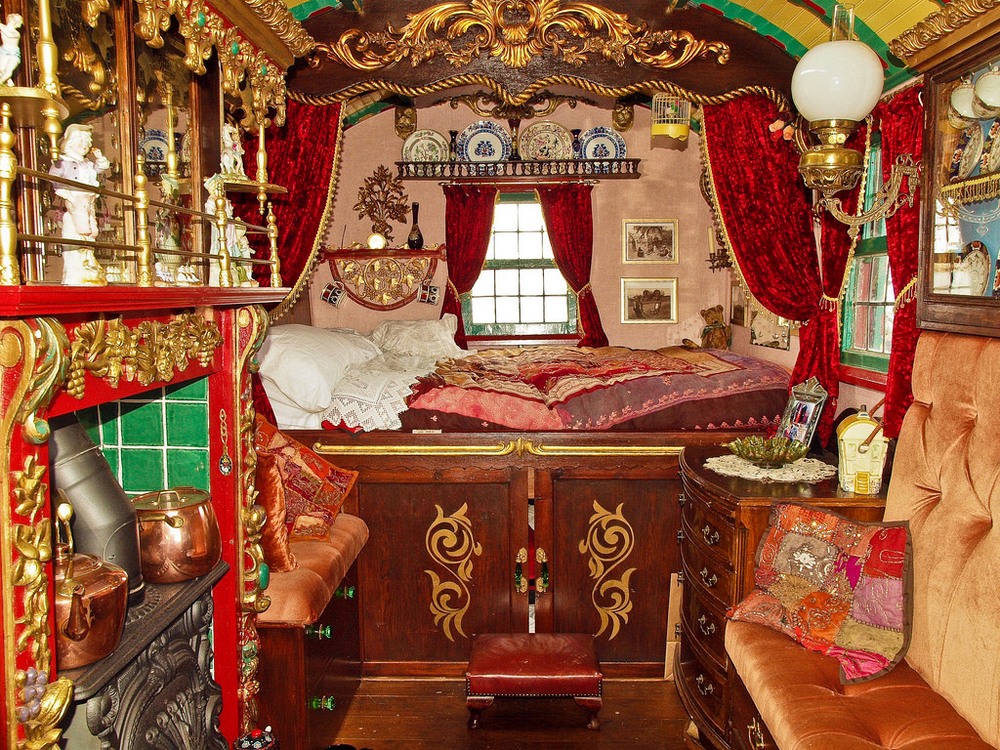
Travelling showmen spent most of their lives on the road but instead of pitching tent wherever they went, they had horse-drawn wagons where they cooked, ate, and slept. Later, around the middle of the 19th century, these caravans were adopted as living quarters by the Romani people, commonly called the Gypsies. These people originated from northwestern India, a country their forefathers left some 1,500 years ago and settled in different parts of the world, but mostly in Europe and Mid-West Asia.
The Romanis call their wagons vardo, originating from the Ossetic word “vurdon” for cart. They are smaller than the larger transport wagons the circus troupes used, and thus required fewer horses to pull. They are often highly decorated, intricately carved, and brightly painted. Some are even gilded.
The Gypsies took great pride in their homes on wheels, but as the vardo evolved and grew more ornate, they became more a showpiece than practical sleeping quarters. Indeed, few Gypsies actually slept in them, preferring instead to sleep in tents or beneath the wagon itself. They also lacked sentiment in times of need, having no hesitation in selling them for something else. Yet, when the owner died it was the custom to burn all his belongings, including the vardo, for the Romanis believed that a dead person’s possessions should not be sold. Money and jewellery, however, was left to the family.
Vardos proliferated in the late 19th and early 20th century. This period is often affectionately called “the wagon time” by Romanichal travellers. 
Vardos are categorized into six main styles—Brush wagon, Reading, Ledge, Bow Top, Open lot, and Burton. The general design evolved over time and were named after the home's owners, for their traditional style (Ledge), for the town of its construction (Reading), or for the name of the builder.

I'm Currently writing book four of the DI Sonny Russell series of crime novels, BLOOD ON THE CARDS. Much of the action revolves around a fairground in the 1950s, when Vardos were commonplace. Here is an extract from the first draft, describing the main suspect and his ornate caravan.

He stopped in front of an impressive living wagon. It was painted a deep maroon, the panels expertly lined out in gold, standing on pneumatic tyres. At the foot of the short flight of steps stood a polished milk churn. Another dog lay beside it, quiet this time, head on paws, one watchful eye open.
‘Dad!’ the boy yelled. ‘Da-ad!’
The door of the wagon opened and man appeared. His frame was stocky, but muscular; his curly blond hair flopped over his forehead, startling blue eyes flashed beneath. He was wearing a collarless shirt open to reveal a thick matt of hair, with a red spotted scarf, knotted round his throat. His legs were clad in a pair of corduroy trousers, cinched at the waist with a thick leather belt. ‘What?’ he growled. ‘What do you want? D’you know what time it is?’
The boy shook himself free. ‘Sorry Dad. These rozzers wanted to talk to you.’ He dashed off again. They didn’t see him disappear round the corner and run up the steps of the strongman’s van.
Weeks took a step forward. ‘Sorry, sir. Could we have a word with you?’
The man scowled, a look of defiance spoiling his matinee looks. ‘Go on. I’m listening.’
‘Could we come inside? It’s a rather delicate matter.’
‘I suppose so.’ He turned and went back into the van. The two constables looked at each other. Nettie mounted the steps followed by Weeks.
The interior of the wagon was a symphony in mahogany and brass. Everything was polished to a high gleam, reflected in numerous ornate mirrors. They were invited to sit on a plush, fitted settee, opposite an immaculate cast iron range. A cheery blaze flickered behind the glass door.
‘Right then. What can I do for you?’ He stood in front of the fireplace, his muscular arms folded across his chest.


I hope to publish BLOOD ON THE CARDS later this year, but meanwhile, the other books in the series are available in paperback or on Kindle. Details are on the right of the blog. 


Monday, 15 July 2019

BUDDHA and the art of meditation

BUDDHA
and the art of meditation


For 20 years I practiced as a Buddhist. I meditated regularly at home, took part in weekend retreats and attended meditation groups in a Buddhist retreat centre. Here, I led meditation, going through the process of relaxation and emptying the mind; getting rid of 'the chattering monkeys' or at least learning not to concentrate on them. I wouldn't say I became an experienced meditator but the practice and ethos of Buddhism remains with me.

In my second DI Sonny Russell crime novel much of the action takes place at a Buddhist retreat he is attending. In this extract from BLOOD ON THE SHRINE, a very experienced meditator is found dead. 
If you would like to know more, paperback copies of this book as well as kindle are available on Amazon. (All three books in the series are readily available). 


‘Do you think he died of natural causes?’ Russell was in the monks’ compact office in their private quarters. He was speaking to John Crooks, the pathologist back in Collinghurst.
          ‘Difficult to say, without being there. Tell me again how you found the poor unfortunate.’
          ‘He was sitting very still, and had been for some hours apparently. He was cross-legged, in the Lotus position, with his hand folded together in his lap. One of the other monks, seeing that the temperature had dropped, had wrapped a blanket round his shoulders. I think there was a sliver of glass caught in the material and when Karunavadra put the blanket round it went into his jugular. What I don’t understand is why he didn’t feel it and react. Instead he just seems to have bled to death.’
‘Did you say he is, or was, a very experienced meditator?’
‘Yes, as far as I can make out he’d been meditating for many years and had perfected the ability to go into a deep, trance-like state.’
Crooks was quiet for a moment and there was just the sound of crackling on the line. Russell was about to speak again when the pathologist answered. ‘Ah … that could be the reason. It is my understanding that through meditation, some yogis are able to reduce heartrate and pulse to such a low level that the body goes into a sort of hibernation. I would imagine that when they are in this state, they can remain unaffected by external conditions or stimuli.’


Thursday, 27 June 2019

TELEPHONE BOX - press button A


TELEPHONE BOX - press button A


Sir Giles Gilbert Scott was an English architect known for his work on Battersea Power Station, Cambridge University Library, Liverpool Cathedral and Waterloo Bridge and for designing the iconic red telephone box.

Before the advent of mobile phones, everybody used GPO telephone boxes. They often smelled rather unsavoury, were cold and draughty but provided a lifeline for those who didn't have a household phone. I well remember putting four (old) one penny coins in the slot, waiting for a reply, then pressing button A, before speaking. If no one answered, you pressed button B and got your money back. I've used them in my books and here are two extracts featuring them. 

BLOOD ON THE SHRINE

"Baker had found plenty of kindling wood around the yard behind the farmhouse and had the stove burning merrily. He put some larger pieces in, shut down the damper and set off to find a phone box. He assumed there would be one in Framfield so headed in the direction of the village. He passed the gate leading down to the level crossing then continued east. After another 10 minutes he reached the outskirts of the village and soon spied the distinctive red form of the Gilbert Scott-designed call box. The street was deserted and he scuttled inside, the door slowly closing behind him. It had the usual smell of stale tobacco smoke and urine. He inserted four pennies in the slot and dialled the number for the pub in Collinghurst, as Tommy had said he would be waiting for his call at that time.

          ‘Hello? Queen’s Head,’ a male voice said.
          He pressed button A. The coins clattered into the box. ‘Oh, hello, is Tommy there?’
          ‘Hang on.’ The line crackled. He could hear the landlord calling, ‘Tommy! Call for you.’
          There was a pause, then, ‘’Ello? Who’s that?’
          ‘It’s me, Laurie.’
          ‘’Ello mate. ’Ow you doin’?’
          ‘I’m alright thanks.’
          ‘’Ave you been to the farm’ouse?’ Waddyer think?’
          ‘Yes, it’s fine. Just as you described.’
          ‘Told you it would be alright.’ Baker could picture Tommy smiling. ‘Where are you now?’
          ‘Call box in Framfield.’
          Atkin’s tone changed. ‘Anybody see yer?’ he growled.
          ‘No mate. It’s all quiet here.’
          ‘Make sure it stays that way. Don’t want nobody gettin’ suspicious.’
          Baker was a bit peeved. ‘Here, hang on…’
          Atkins relented. ‘It’s all right. Keep yer ’air on. Just need to stick to the plan. You stay put and I’ll come and find yer.’
          ‘When are you coming, Tommy?’
          ‘I’ll be over in a day or two. Got enough grub to keep you goin’?’
          ‘Enough for a day or two I guess.’ Baker sounded unsure.
          ‘Don’t worry cocker, you could always go and snare a rabbit,’ Atkins chuckled.
          ‘Or pop into the village shop?’ Baker said hesitantly.
          ‘Don’t you bloody dare!’ Atkins sounded murderous, his mood changing like the wind. ‘I’ll bring the food.’
          ‘All right, Tommy. Don’t worry, I won’t. Just don’t leave me on my own for too long. You know I hate the countryside.’ The pips sounded on the line. ‘I’ll put some more money in,’ Baker said, panic in his voice.
          ‘Don’t bother mate, ring me tomo…..’ Atkins’s voice was cut off as the money ran out.
          Baker put the receiver down gently. The man had the ability to boost your ego or leave you deflated and Atkins’s words had left him feeling hollow. He pushed the heavy door open and set off back to the farmhouse." 


 BLOOD ON THE STRAND


"Nettie made her way to the red phone box, pulled the door open and settled inside, making herself as comfortable as she could for what might be a long wait. She could clearly see several hundred yards down the track. After a number of settled days with warm sunshine the weather was changing. The sky was now leaden and threatening; the wind was fickle, alternating between gentle breaths and gusty blasts, shaking the scrubby trees and almost flattening the Marram grass either side of the track. It looked as if rain wasn’t far off. Nettie hoped she wasn’t going to get soaked.
 However, after 20 minutes, she heard the sound of an engine: a plume of dust rose, and was then blown sideways by the wind. She watched eagerly, just as fat blobs of rain hit the windows of the phone box. As more raindrops fell, washing the dust off the glass, she could see the blue Morris bumping slowly along the track. The rain was starting to fall more forcefully now, the gusty wind blowing it at 45 degrees. She took a chance and made a dash for the Ford. Pulling the door open she jumped inside and pulled it closed behind her.
‘The car’s coming!’"

Wednesday, 12 June 2019

Rain, rain go away...

RAIN, RAIN GO AWAY


As it's now been raining, every other day since Saturday, my thoughts turned to the weather, and how I've written about it. Here is an extract from BLOOD ON THE SHRINE to give you a taste of how I described a downpour that put DC Johnny Weeks in serious danger. 

'The rain continued to fall relentlessly. At the back of the farmhouse a cast-iron downpipe had come adrift from its bracket and had swung sideways. So, instead of the water going into a drain, it was discharging the contents of the gutter down through the coal chute and into the cellar. If the hatch at the top had remained in place it would have flowed harmlessly across the yard, but after Weeks’s efforts the water was now forming a pool around his body. The door at the top of the steps opened, the light from the candles in the kitchen too weak to penetrate beyond the first couple of steps.'


I obviously like writing about the weather because the rainy theme continued in BLOOD ON THE STRAND.

'Aggie was delighted to be out – the weather didn’t bother her. Heads down, Russell and Weeks were striding into the driving rain while she scampered around their feet, tail up, revelling in the scents she found along the shoreline. The two men said very little to each other. The roaring of the wind and crashing of the surf made conversation close to impossible. The storm showed no sign of abating; if anything it was increasing. They had been tramping along for half an hour, the rain finding a way into their waterproofs and wellingtons and starting to soak their clothes. Each was waiting for the other to suggest it was time to turn back when the terrier began barking excitedly. Looking up and peering through the spray they could see a large crate slopping backwards and forwards in the surf; each wave pushing it further up the beach, and then dragging it back again. Splashing into the shallows they succeeded, with a struggle, in dragging it out of the water and a little way up the beach. The crate was roughly three feet square by about two feet tall. It was strongly constructed from stout timbers, firmly nailed in place.'


And more from BLOOD ON THE STRAND

'Nettie made her way to the red phone box, pulled the door open and settled inside, making herself as comfortable as she could for what might be a long wait. She could clearly see several hundred yards down the track. After a number of settled days with warm sunshine the weather was changing. The sky was now leaden and threatening; the wind was fickle, alternating between gentle breaths and gusty blasts, shaking the scrubby trees and almost flattening the Marram grass either side of the track. It looked as if rain wasn’t far off. Nettie hoped she wasn’t going to get soaked.
 However, after 20 minutes, she heard the sound of an engine: a plume of dust rose, and was then blown sideways by the wind. She watched eagerly, just as fat blobs of rain hit the windows of the phone box. As more raindrops fell, washing the dust off the glass, she could see the blue Morris bumping slowly along the track. The rain was starting to fall more forcefully now, the gusty wind blowing it at 45 degrees. She took a chance and made a dash for the Ford. Pulling the door open she jumped inside and pulled it closed behind her.'

Sunday, 26 May 2019

CALM SEA AND A PROSPEROUS VOYAGE.

CALM SEA AND A PROSPEROUS VOYAGE

Rowland Hilder - Newhaven Harbour

The sea has long been an inspiration for artists, writers and musicians. Many of Turner's paintings featured the sea, in all its moods. Benjamin Britten wrote incredibly atmospheric music for his opera, Peter Grimes, called Four Sea Interludes. You only have to close your eyes to imagine the crashing surf and rolling breakers. However, the sea isn't always rough and tempestuous. Two composers, Ludwig van Beethoven and Felix Mendelssohn were inspired to write pieces of music with the title 'Calm sea and a prosperous voyage', with the sea in more passive mood. Rowland Hilder, a twentieth century painter I much admire, painted many peaceful scenes, like the one above. 

The sea plays a large part in my writing, as the detective, DI Sonny Russell, lives in an old railway carriage, close to the shore, so much of the action features the sea, and those connected with it. At times, as in the opening to Blood on the Strand, the sea is an uncontrolled monster, spiteful and menacing hurling spray and threatening lives. At others, I try to portray it in gentler mood, as in this extract from Blood on the Tide

Russell is crossing the channel on a ferry, the Cote d'Azure, newly commissioned in the 1950's when the story is set.

The ship was not only clean and bright but fairly quiet. Few passengers seemed to be crossing the Channel at that time. It was a balmy afternoon and the sea was almost flat calm, promising a smooth passage. As the Côte D’Azur steamed out of Dover Harbour he leant on the taffrail, watching the wake tumbling and foaming, the spring sun lighting up the white cliffs. He found the scene quite soothing and felt the worries of the case begin to fade away, although he knew it would only be for a short while. As the white cliffs of England faded into the distance, he strolled contentedly in to the cafeteria, ordered coffee and a pastry and found a vacant seat next to the window. He had brought his notes but was happy to leave the file closed and enjoy the journey. In little more than an hour the coast of France hove into sight and a voice on the Tannoy announced it was time to prepare to disembark. The carefree mood he had enjoyed during the crossing faded as he prepared for what he feared might be a trying time.

You can read more of DI Sonny Russell's adventures with his little Jack Russell, Aggie, in my series of crime novels, set in the post-war 1950's.

Sunday, 21 April 2019

ACTION! Setting the scene.

ACTION!
Setting the scene

Compass Point - bomb disposal

As documented before on the blog, my 009 layout, Compass Point is the inspiration for my series of DI Russell crime novels. Several of the tableaux I created were featured in the books. Notable amongst them was the scene where a WW2 bomb is being extracted from the mud in the estuary by Captain Valiant and Sapper Rankin.


Now that I'm well into writing the fourth in the series, I am still adding scenes that may be incorporated at some time. I'm currently building a vintage Airfix model of a WW2 'Quad' with 25 pounder gun and limber. I've got this idea that a group of soldiers, on manoeuvres, in the mid 1950s are still using war time equipment. They have lost their way, bumping down a rutted track near Shinglesea Halt, and have stopped to consult the map.


I think it's going to work on the layout, and it's given me an idea for incorporating it into Blood on the Cards, but there's just one small problem. The figures. British army soldiers, in 1/72 and 1/76 scale are readily available, but they are mainly in action poses. There are some very nice wargaming figures, but at only 20mm high they are rather too short, scaling out at about 5 feet tall. So the search goes on.


Tuesday, 16 April 2019

LOOK AT ME! - Making an exhibition of myself

LOOK AT ME!
Making an exhibition of myself


Following on from my last post, Publish - and hope not to be damned, I have just undertaken the launch and book signing of my third novel BLOOD on the STRAND. The Rye Bookshop were kind enough to play host and at 12 noon on Saturday 13th April, I was set up and waiting for customers.

Castle Quay

I'd taken a railway layout I'd built in an empty winebox, called Castle Quay. It was quite relevant as it features models of the Hastings net huts, which play an important part in the book. The shop was busy and it was gratifying to talk to quite a few people who were interested in the book and by 2.30pm I had signed and sold a number of copies.


I'm planning on taking part in a meet the author - and his dog - at several venues in the near future. These include The Romney Marsh Visitor Centre, The Rye Heritage Centre and The Hasting Fishermen's Museum. So watch out for announcements.


Friday, 5 April 2019

PUBLISH - and hope not to be damned

PUBLISH
and hope not to be damned


As a self -published author, I hope to be received kindly and, judging by the response from readers, it seems that people like my writing. Nowadays, it's just not possible to get your manuscripts accepted by a publisher, you have to go through an agent, first. I must have written to well over 50 agents and, when they did reply is was the 'thanks, but no thanks' email. So, still being determined to see my work in print, I set up my own publishing company, BOGHOPPER BOOKS.


It may sound grand, but basically, it's me, working in my railway carriage studio. I have to actively engage with social media, promoting and publicising my books; store my books, then package and send them to those kind enough to buy them, and send out press releases. I promote the books when I give talks to WI, gardening clubs, U3A and other groups. I have to arrange to launch the books in the local Rye Bookshop, which has been very supportive. And... keep in touch with the outlets that stock my books to make sure they have sufficient copies. 

Then, on top of all this I actually have to find time to sit down and WRITE!


Saturday, 30 March 2019

NEW BOOK! - You can judge a book by its cover

NEW BOOK!
You can judge a book by its cover


There's very little more exciting for a writer, than holding the first printed copy of a new book. You've spent getting on for a year, sitting at the keyboard, shaping and crafting prose into a form that you hope will engage readers for 300 hundred pages or so. Then you go over the first draft, chopping out chunks, adding new bits and generally honing it. Next, you give it to an editor, and hope they won't want to change it too much. (I'm lucky as my better half was a sub-editor on The Daily Telegraph for 25 years.) We discuss changes and improvements, which I might or might not agree with. After all it is my book. Then you pass it on to a Beta Reader, a trusted friend who will be honest and also find mistakes that we've missed. 
A friend, another journalist, pointed out, when you write 80,000+ words, you wouldn't be human if you missed some errors. (He also said: What I thought was amazin’ was the punctuation of conversation. Never seen so many apostrophes, and all spot on.)
Next, it goes to the printer, who sets it out then sends you a draft copy which you go over yet again, making a note of changes which need to be made before the final print run.


Once the words are sorted out, getting the cover right is the next task, and probably the most important for sales in bookshops and online. As a designer, I like to try out ideas for the cover, as shown above. I thought mine were quite good but, I realise my limitations, I am not a book cover designer. Luckily, I have a neighbour, with many years experience in graphics, working on magazines. Plus, he is an avid reader and I trust his judgement. He has been happy to produce the covers for all three of my books. And when he showed me the cover he'd come up with for BLOOD ON THE STRAND I couldn't have been happier. Although he had only read the synopsis his image captured the atmosphere of the book perfectly.


So, the book is written and edited, the cover is designed and finally it's printed. But does it stop there? No, of course it doesn't. Now comes the hard graft of publicity and promotion: social media, forums, public appearances, talks, book launches etc etc. You have to be proactive and engage in as many different ways to get readers to buy your baby - there's a mountain of competition out there. Hence, this blogpost which may, or may not result in a sale or two. So over to you, dear reader.