Followers

Showing posts with label bookstagrammer. Show all posts

Friday, 15 November 2019

SUCCESS 95% perspiration 5% inspiration

SUCCESS
95% perspiration 5% inspiration


Sorry for garbling the quote in the title, which should be "Success = 90% perspiration, 10% inspiration", but as a struggling author I see the odds as being somewhat lower. Most of my time as a writer is spent with my head down, conjuring up pithy combinations of words and amusing phrases and turning them into prose. Then creating stories that, hopefully, my readers will find worthwhile spending time with.

You might think that it is a  solitary life, and in some ways it is. But it's never lonely. The English language is so rich, it's like being in the company of a highly amusing and intelligent group of friends. If just writing was the measure of my success it would be close to 100%. Not for the quality and richness - I have no illusions about my abilities - I know I'm good (head swells) but not that good, compared to the greats. But, looking over what I've put down on the page gives me great satisfaction. If that was all it was about, I'd be a very happy man. But... getting the words down, then corrected and edited is only a small part of the writers burden. 


I'm pretty good at self-publicity. I don't mind standing in front of an audience, selling myself. I don't mind driving distances, to promote my books to a small audience and I don't mind constantly posting on social media making sure I have a high enough profile. There's a saying that "half the money spent on advertising is wasted, but you don't know which half". Not being well off, I can't afford to spend much  on advertising so that doesn't really work for me. So, I do what I can - public appearances and book-signings, personal delivery of books, shameless advertising when people find out I'm a writer. Also, I give talks to WI, U3A and other groups, mainly on gardening subjects, but I still promote my novels whenever I can.

So, if the process of writing is quite straightforward and painless, the 95% perspiration, or hard graft is when I come to actually sell the damn things. So please, if you like what I've done, please lend a hand by spreading the word. Thank you. 


Wednesday, 23 October 2019

JOURNEY'S END - well not quite

JOURNEY'S END
well not quite
A few days ago I finished writing the fourth book in the DI Sonny Russell series of crime novels, BLOOD ON THE CARDS. It came as something of a surprise.

I started writing it back in December 2018 with only the germ of an idea  - that the body of a fortune teller would be found in a WW2 pillbox near Appledore in Kent. Besides that, I hadn't a clue where the story was going to take me. 

I remember listening to Anne Cleeves, the author of the Shetland and Vera novels that have been so successfully transferred to the small screen. She was choosing her eight records on Radio 4's Desert Island Discs and said there were two types of writers - plotters and pantsters. 


Plotters know exactly where they are going, even to the extent of creating a graph or wall chart, showing the characters, the locations and the plots and just how they are going to react with each other. Pantsters, on the other hand, literally fly by the seat of the pants, following every twist and turn of the story they are creating. Writing like a reader, they are never sure where the narrative is going to take them. I'm one of those. 

I do enjoy the writing, above everything else - editing and promotion for instance - and feel quite bereft when I come to the end of a story that I have been wrapped up in for nearly a year. I would quite like to get on with the next instalment, but first the hard work really starts.

I will have to go through this first draft, carefully checking for inaccuracies, to make sure the chronology is correct and that the narrative floes. I will then hand my baby over to my better half, Greer, who after a lifetime in journalism is more than qualified to check for errors I've missed. I then like to pass it on to a beta reader* to get his opinion of the story. (Very sadly, a good friend who fulfilled that function on the last manuscript, passed away recently so I will have to find another trusted friend to take his place. Not an easy task.)

Then, when all are satisfied, it's off to the printer. So, although the writing is done, there's still a long way to go. However, if you haven't already met DI Sonny Russell, Aggie, his faithful Jack Russell terrier and DC Johnny Weeks, the first three books are available in paperback or kindle.

*A beta reader is usually an unpaid test reader of an unreleased work of literature, who gives feedback from the point of view of an average reader to the author.


Thursday, 3 October 2019

A DIFFERENT SORT OF EXHIBITION

A DIFFERENT SORT OF EXHIBITION

Fresh fish stall at Compass Point.

As well as writing books and designing gardens, I also find time to model narrow gauge railway layouts. In a former life I was a professional model maker, making, amongst other things, houses, teapots, cars and robots in a variety of materials. Most of the time I was up against a deadline and tied to a maximum price, which could often lead to a feeling of stress. I'm glad to have left that behind and can now make models, purely for my own pleasure - without the stress. Well, up to a point. For my sins, I take my model railways to exhibitions. As the current layout, Compass Point, is the inspiration for my crime novels, I take some books along too.

DI Sonny Russell's railway carriage home


The shows are usually great fun, I meet lots of nice people and receive compliments for my work. Usually. Generally, the exhibitions are reasonably close to home and just for one day, plus my friend Terry comes with me and is happy to transport the layout in his transit van. However, I've agreed to take part in a two day exhibition in Fareham, which is a two-and-a-half-hour drive away, so I will need an overnight stay. In addition, Terry isn't coming so I've had to pack everything into our Fiat 500!

Everything packed in a Fiat 500

Luckily Terry came round and he helped carry everything down from the studio. Set up, the layout is a total of 2.8 metres long or over nine feet. In addition there are trestles to support it plus a proscenium arch and lighting board - also, rolling stock, transformers, cables, tools etc, etc. Not to mention an overnight bag and a box of books for sale. Phew! It was a struggle to get everything in and I made sure to take photographs so I know how to repack it on Sunday after the show. Hopefully I'll sell a few books, which will help to make it worthwhile. Not sure I'll accept the invitation for another two day, long-distance exhibition again. Unless I hire a van, of course.


If you're anywhere near Fareham this weekend, do come and say hello. http://fareham-mrc.org.uk/railex-2019/

If not, remember, you can obtain my books and kindles on Amazon 


Wednesday, 18 September 2019

MEET THE AUTHOR - making another exhibition of myself

MEET THE AUTHOR
making another exhibition of myself


As an author with my own publishing company I have to wear several hats. As I writer, my life is, by nature, solitary. I work either on my laptop in bed (!), in the sun room or sitting on the sofa when there's something on the TV that doesn't grab my attention. Bed is nice, as I have distant views of the sea and the sun room looks over the garden. However, the best place is in my purpose-built studio.


Built around the backdrop for my medal-winning 2007 Chelsea Flower show garden it looks, and feels, like a railway carriage. I have even better views of the channel, which can be distracting when an interesting ship sails down-channel. 


However, the hat I love and dread wearing in equal measures is the one when I'm promoting my books. It means meeting the public - something I really enjoy as I love talking to people. But it brings the stress of having to perform along with periods of inactivity, waiting for the public to turn up. On top of that, I tend to stand up for long stretches and that plays havoc with my lower back. But, it has to be done. 

So, if you see me at one of my book-signing or meet the author and his dog days, please say hello but also feel a little sorry for me.


Tuesday, 20 August 2019

KILROY WAS HERE - wot no sugar

KILROY WAS HERE - wot no sugar


While writing my current book, BLOOD ON THE CARDS, I researched wartime graffiti. I wanted to describe the interior of a WW2 pillbox where the body of a fortune teller is found. I decided to use this one. Not sure if it actually existed but it amused me to think it might have.


Also, 
YANKS GO HOME

This would have been quite common at the time. 

But one that was seen all over during that period was KILROY. The figure was initially known in the United Kingdom as MR CHAD and would appear with the slogan "Wot, no sugar" or a similar phrase bemoaning shortages and rationing.He often appeared with a single curling hair that resembled a question mark and with crosses in his eyes.The phrase "Wot, no —?" pre-dates "Chad" and was widely used separately from the doodle. Chad was used by the RAF and civilians; he was known in the Army as Private Snoops, and in the Navy he was called The Watcher.


Even older was FOO who predates Kilroy by about 25 years.


Monday, 12 August 2019

ALEISTER CROWLEY & the esoteric Tarot

ALEISTER CROWLEY
&
The esoteric Tarot

Aleister Crowley was an English occultist, ceremonial magician, poet, painter, novelist, and mountaineer. A prolific writer, he founded the religion of Thelema and published widely over the course of his life.

So begins Chapter 6 of BLOOD ON THE CARDS, the fourth book in the DI Sonny Russell crime series I am currently writing. The story revolves around the death of a fortune teller at a funfair on the Salts at Nottery Quay (a thinly veiled Rye, in East Sussex.)

As Tarot cards play a large part I needed research into their origin and meanings. Back when I as a callow youth I became very intrigued by this branch of divination and even started telling peoples fortunes, using them. I probably wasn't very good but found it fascinating.


As a result of my recent research, I discovered that Aleister Crowley had designed, with paintings by Lady Frieda Harris, a beautiful deck called the Thoth Tarot. I also discovered that he spent his last years in a nursing home/lodging house on The Ridge in Hastings. 


This was in the 1970s and what was left of the building subsequently became the Robert de Mortain pub. Sadly this is no more. Although I understand that it was never a great pub, the building of The Conquerors March, just up the road, sounded its death knell. (It really annoys me that this corporate chain place, not dissimilar to a Beefeater, lacks an apostrophe!)


The pub was demolished and houses have now been rapidly thrashed up on the site and it amuses me to think that the ghost of Aleister Crowley, once called the most evil man in Britain, may haunt these charmless boxes!


Tuesday, 6 August 2019

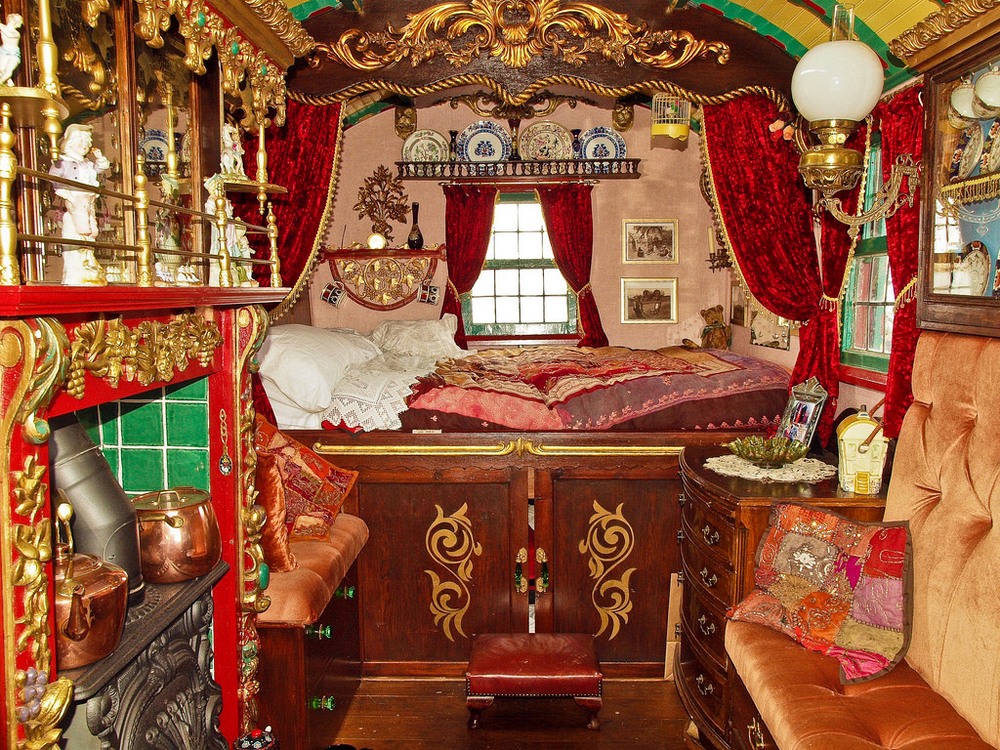
VARDO - Romani Wagon

VARDO
Romani Wagon


Travelling showmen spent most of their lives on the road but instead of pitching tent wherever they went, they had horse-drawn wagons where they cooked, ate, and slept. Later, around the middle of the 19th century, these caravans were adopted as living quarters by the Romani people, commonly called the Gypsies. These people originated from northwestern India, a country their forefathers left some 1,500 years ago and settled in different parts of the world, but mostly in Europe and Mid-West Asia.
The Romanis call their wagons vardo, originating from the Ossetic word “vurdon” for cart. They are smaller than the larger transport wagons the circus troupes used, and thus required fewer horses to pull. They are often highly decorated, intricately carved, and brightly painted. Some are even gilded.
The Gypsies took great pride in their homes on wheels, but as the vardo evolved and grew more ornate, they became more a showpiece than practical sleeping quarters. Indeed, few Gypsies actually slept in them, preferring instead to sleep in tents or beneath the wagon itself. They also lacked sentiment in times of need, having no hesitation in selling them for something else. Yet, when the owner died it was the custom to burn all his belongings, including the vardo, for the Romanis believed that a dead person’s possessions should not be sold. Money and jewellery, however, was left to the family.
Vardos proliferated in the late 19th and early 20th century. This period is often affectionately called “the wagon time” by Romanichal travellers. 
Vardos are categorized into six main styles—Brush wagon, Reading, Ledge, Bow Top, Open lot, and Burton. The general design evolved over time and were named after the home's owners, for their traditional style (Ledge), for the town of its construction (Reading), or for the name of the builder.

I'm Currently writing book four of the DI Sonny Russell series of crime novels, BLOOD ON THE CARDS. Much of the action revolves around a fairground in the 1950s, when Vardos were commonplace. Here is an extract from the first draft, describing the main suspect and his ornate caravan.

He stopped in front of an impressive living wagon. It was painted a deep maroon, the panels expertly lined out in gold, standing on pneumatic tyres. At the foot of the short flight of steps stood a polished milk churn. Another dog lay beside it, quiet this time, head on paws, one watchful eye open.
‘Dad!’ the boy yelled. ‘Da-ad!’
The door of the wagon opened and man appeared. His frame was stocky, but muscular; his curly blond hair flopped over his forehead, startling blue eyes flashed beneath. He was wearing a collarless shirt open to reveal a thick matt of hair, with a red spotted scarf, knotted round his throat. His legs were clad in a pair of corduroy trousers, cinched at the waist with a thick leather belt. ‘What?’ he growled. ‘What do you want? D’you know what time it is?’
The boy shook himself free. ‘Sorry Dad. These rozzers wanted to talk to you.’ He dashed off again. They didn’t see him disappear round the corner and run up the steps of the strongman’s van.
Weeks took a step forward. ‘Sorry, sir. Could we have a word with you?’
The man scowled, a look of defiance spoiling his matinee looks. ‘Go on. I’m listening.’
‘Could we come inside? It’s a rather delicate matter.’
‘I suppose so.’ He turned and went back into the van. The two constables looked at each other. Nettie mounted the steps followed by Weeks.
The interior of the wagon was a symphony in mahogany and brass. Everything was polished to a high gleam, reflected in numerous ornate mirrors. They were invited to sit on a plush, fitted settee, opposite an immaculate cast iron range. A cheery blaze flickered behind the glass door.
‘Right then. What can I do for you?’ He stood in front of the fireplace, his muscular arms folded across his chest.


I hope to publish BLOOD ON THE CARDS later this year, but meanwhile, the other books in the series are available in paperback or on Kindle. Details are on the right of the blog. 


Sunday, 28 July 2019

OF SHOES AND SHIPS AND SEALING-WAX...

OF SHOES AND SHIPS AND SEALING-WAX...

The time has come,' the Walrus said,
      To talk of many things:
Of shoes — and ships — and sealing-wax —
      Of cabbages — and kings —
And why the sea is boiling hot —
      And whether pigs have wings.'

This verse from the wonderful nonsensical Lewis Carroll poem, ‘The Walrus and the Carpenter’ has long been a favourite of mine. I started sailing in dinghies when I was 11 years old. My brother had just finished the construction of the first boat he built, a Mirror dinghy. (He has subsequently built several larger craft, including one in which he circumnavigated the world - but that's another story.) He'd met me from Sunday School - I was still wearing my Sunday best - and we'd made our way to Mitchell's boatyard in Poole Harbour, where the dinghy was kept. The boat was launched and I was made to sit on the thwart (seat) amidships and told not to move, only to duck when the boom came across. Thus began my love of boats, the sea and everything connected with them. So, it comes as no surprise that these things feature largely in my crime novels.


The stories are set near the sea and often involve fishermen and boats. In the first two books, BLOOD ON THE TIDE and BLOOD ON THE SHRINE the 'baddies have a boat called MOONSHINE. I'd chosen the name for no other reason than it has connotations of illicit activities. Imagine my surprise when later, after the stories were written, I was mooching around the iconic net sheds at the fishermen's beach in Hastings and saw this, an old photo, framed and displayed on one of the sheds. I had no idea there had actually been a Hastings boat called MOONSHINE. Serendipity or what?!


It was too late to change the name so I hope no one is offended. Here is an extract from BLOOD ON THE SHRINE when the 'baddies' are making their escape.

Salt was doing his best to delay Moonshine’s departure but was struggling to slow it down. ‘Why in such a hurry? The tide’s only just making and there’ll be plenty of water when you get there.’
Dickens continued loosening the ropes. ‘Aye. Just feel it’s best to get under way. Want to take it easy, just to make sure.’
Salt tried one more tack. ‘Might it not be wise to leave it, until you’ve had enough time to check the engine is running all right?’
Dickens paused and listened. ‘Sounds all right to me. I think I’d know if anything was up, don’t you?’ Anxious to start the journey he was beginning to suspect that Salt might be deliberately delaying him. He finished untying the warps, threw the stern line untidily down on to the afterdeck and looped the bowline round the bollard. He jumped down on to the deck, pulled the line in behind him and, with a wave to Salt, began turning the boat. The tide was coming in swiftly and the boat slewed sideways, travelling back up the river, before Dickens got the bow pointing seaward. Even at half throttle Moonshine barely made headway against the current so he gave the engine more revs and she began moving slowly down the estuary, a large bow wave breaking either side of the vessel.
She hadn’t gone more than a couple of hundred yards when Salt heard a car approaching at speed. The Wolseley rocketed over the level crossing - the front bouncing high on its springs - and into the yard, screeching to halt surrounded by a plume of dust. Russell and Beaumont tumbled out and ran to where Salt was standing. ‘Where is she?’
Salt pointed down the channel. ‘There! They’re getting away!’
‘Not if I have anything to do with it! Quick, get Stan. We need to get after them!’ Salt ran to the boatshed while the two policemen climbed down the ladder and into the launch. By the time Stan had joined them, the engine was running and the warps were untied. Moonshine was some distance away and Dickens had obviously opened the throttle fully as she was now creating an even larger bow wave. ‘Can you catch her?’ Russell asked.
‘I’ll give it my best shot,’ Stan said.
‘If Wolfgang’s aboard, I don’t want to lose him again!’

Monday, 15 July 2019

BUDDHA and the art of meditation

BUDDHA
and the art of meditation


For 20 years I practiced as a Buddhist. I meditated regularly at home, took part in weekend retreats and attended meditation groups in a Buddhist retreat centre. Here, I led meditation, going through the process of relaxation and emptying the mind; getting rid of 'the chattering monkeys' or at least learning not to concentrate on them. I wouldn't say I became an experienced meditator but the practice and ethos of Buddhism remains with me.

In my second DI Sonny Russell crime novel much of the action takes place at a Buddhist retreat he is attending. In this extract from BLOOD ON THE SHRINE, a very experienced meditator is found dead. 
If you would like to know more, paperback copies of this book as well as kindle are available on Amazon. (All three books in the series are readily available). 


‘Do you think he died of natural causes?’ Russell was in the monks’ compact office in their private quarters. He was speaking to John Crooks, the pathologist back in Collinghurst.
          ‘Difficult to say, without being there. Tell me again how you found the poor unfortunate.’
          ‘He was sitting very still, and had been for some hours apparently. He was cross-legged, in the Lotus position, with his hand folded together in his lap. One of the other monks, seeing that the temperature had dropped, had wrapped a blanket round his shoulders. I think there was a sliver of glass caught in the material and when Karunavadra put the blanket round it went into his jugular. What I don’t understand is why he didn’t feel it and react. Instead he just seems to have bled to death.’
‘Did you say he is, or was, a very experienced meditator?’
‘Yes, as far as I can make out he’d been meditating for many years and had perfected the ability to go into a deep, trance-like state.’
Crooks was quiet for a moment and there was just the sound of crackling on the line. Russell was about to speak again when the pathologist answered. ‘Ah … that could be the reason. It is my understanding that through meditation, some yogis are able to reduce heartrate and pulse to such a low level that the body goes into a sort of hibernation. I would imagine that when they are in this state, they can remain unaffected by external conditions or stimuli.’


Thursday, 11 July 2019

FLOATING TO WISSANT - a ride in a Citroën DS

FLOATING TO WISSANT
a ride in a Citroën DS

Wimereux

In my 1950s crime novel, BLOOD ON THE TIDE, I describe a journey my detective, DI Sonny Russell, makes with his friend, Inspecteur Guillaume Bruissement in a Citroën DS he has been given on trial. They travel north from Boulogne to Wissant, passing through several villages. I know that part of the coast very well and can confirm that it is a most interesting drive and the villages are well worth exploring. 

"The car all but floated over the rough roads through the town and they were soon out in the countryside. They passed through Wimereux, which showed signs of rebuilding after operation Wellhit in WW2. Then the villages of Ambleteuse, Audresselles and Audinghen before arriving twenty minutes later in the village square of Wissant. To one side was the squat bulk of the 15th-century church of Saint Nicholas, next to it the WW1 memorial. Nearby was the half-timbered Hotel Normandy and on the other side of the road, a low stone building, with a tractor and substantial wooden fishing boat on a trailer standing outside. ‘That is a flobart, a fishing boat particular to this region,’ Bruissement  explained, as he got out of the car. ‘The tractor takes the boat down to the beach and launches it into the sea. They catch some wonderful fish that are served fresh here in Le Vivier!’ Russell, getting out of the car to stand beside him, smiled."

Ambleteuse - Fort Mahon

Audresselle

We even made up this little rhyme, to the tune of, 'Do you know the muffin man! 

Savez-vous l'homme du moule, l'homme du moule, l'homme du moule.
Savez-vous l'homme du moule, l'homme du moule, l'homme du moule
Qui habite a Audresselles.


Audinghen - church of St Pierre

I'm told the fish is indeed wonderful and fresh (although, like Sonny, I don't eat fish) and the coast has lots of other attractions - sandy beaches, lots of rock pools as well as museums dedicated to WW2. Batterie Todt at Audinghen, housed in a huge German-built blockhouse, has a fascinating collection of artifacts from the period.

Wissant - Le Vivier

The photo above shows one of the traditional Flobart fishing boats outside Le Vivier. Sadly this has gone but I believe the restaurant is as good as ever.

               "‘Ah, I am sorry my friend, you don’t eat fish. I ’ope you don’t mind if I do?’
          ‘Of course not,’ Russell replied. ‘Just as long as I don’t have to.’ His eyes twinkled.
          ‘No, no. I said there would be something special for you.’ The Frenchman was as good as his word. Once seated at a table in the cosy restaurant Russell was presented with a plate of slim asparagus spears, topped with a perfectly poached egg. He was a little baffled by the scattering of dark crumbs on the dish. ‘A-ha!’ said the Frenchman. ‘That is the surprise. Do you know what it is?’ Russell shook his head. ‘Truffles!’ Bruissement announced triumphantly. ‘The patron was out early in the woods and brought them back, just for you. Taste,’ he said, gesturing with his knife.
          Russell lifted a forkful of the egg and truffle to his mouth, chewed, then swallowed. ‘Mmm. Slightly earthy, a little like mushrooms,’ he said reflectively."


Thursday, 27 June 2019

TELEPHONE BOX - press button A


TELEPHONE BOX - press button A


Sir Giles Gilbert Scott was an English architect known for his work on Battersea Power Station, Cambridge University Library, Liverpool Cathedral and Waterloo Bridge and for designing the iconic red telephone box.

Before the advent of mobile phones, everybody used GPO telephone boxes. They often smelled rather unsavoury, were cold and draughty but provided a lifeline for those who didn't have a household phone. I well remember putting four (old) one penny coins in the slot, waiting for a reply, then pressing button A, before speaking. If no one answered, you pressed button B and got your money back. I've used them in my books and here are two extracts featuring them. 

BLOOD ON THE SHRINE

"Baker had found plenty of kindling wood around the yard behind the farmhouse and had the stove burning merrily. He put some larger pieces in, shut down the damper and set off to find a phone box. He assumed there would be one in Framfield so headed in the direction of the village. He passed the gate leading down to the level crossing then continued east. After another 10 minutes he reached the outskirts of the village and soon spied the distinctive red form of the Gilbert Scott-designed call box. The street was deserted and he scuttled inside, the door slowly closing behind him. It had the usual smell of stale tobacco smoke and urine. He inserted four pennies in the slot and dialled the number for the pub in Collinghurst, as Tommy had said he would be waiting for his call at that time.

          ‘Hello? Queen’s Head,’ a male voice said.
          He pressed button A. The coins clattered into the box. ‘Oh, hello, is Tommy there?’
          ‘Hang on.’ The line crackled. He could hear the landlord calling, ‘Tommy! Call for you.’
          There was a pause, then, ‘’Ello? Who’s that?’
          ‘It’s me, Laurie.’
          ‘’Ello mate. ’Ow you doin’?’
          ‘I’m alright thanks.’
          ‘’Ave you been to the farm’ouse?’ Waddyer think?’
          ‘Yes, it’s fine. Just as you described.’
          ‘Told you it would be alright.’ Baker could picture Tommy smiling. ‘Where are you now?’
          ‘Call box in Framfield.’
          Atkin’s tone changed. ‘Anybody see yer?’ he growled.
          ‘No mate. It’s all quiet here.’
          ‘Make sure it stays that way. Don’t want nobody gettin’ suspicious.’
          Baker was a bit peeved. ‘Here, hang on…’
          Atkins relented. ‘It’s all right. Keep yer ’air on. Just need to stick to the plan. You stay put and I’ll come and find yer.’
          ‘When are you coming, Tommy?’
          ‘I’ll be over in a day or two. Got enough grub to keep you goin’?’
          ‘Enough for a day or two I guess.’ Baker sounded unsure.
          ‘Don’t worry cocker, you could always go and snare a rabbit,’ Atkins chuckled.
          ‘Or pop into the village shop?’ Baker said hesitantly.
          ‘Don’t you bloody dare!’ Atkins sounded murderous, his mood changing like the wind. ‘I’ll bring the food.’
          ‘All right, Tommy. Don’t worry, I won’t. Just don’t leave me on my own for too long. You know I hate the countryside.’ The pips sounded on the line. ‘I’ll put some more money in,’ Baker said, panic in his voice.
          ‘Don’t bother mate, ring me tomo…..’ Atkins’s voice was cut off as the money ran out.
          Baker put the receiver down gently. The man had the ability to boost your ego or leave you deflated and Atkins’s words had left him feeling hollow. He pushed the heavy door open and set off back to the farmhouse." 


 BLOOD ON THE STRAND


"Nettie made her way to the red phone box, pulled the door open and settled inside, making herself as comfortable as she could for what might be a long wait. She could clearly see several hundred yards down the track. After a number of settled days with warm sunshine the weather was changing. The sky was now leaden and threatening; the wind was fickle, alternating between gentle breaths and gusty blasts, shaking the scrubby trees and almost flattening the Marram grass either side of the track. It looked as if rain wasn’t far off. Nettie hoped she wasn’t going to get soaked.
 However, after 20 minutes, she heard the sound of an engine: a plume of dust rose, and was then blown sideways by the wind. She watched eagerly, just as fat blobs of rain hit the windows of the phone box. As more raindrops fell, washing the dust off the glass, she could see the blue Morris bumping slowly along the track. The rain was starting to fall more forcefully now, the gusty wind blowing it at 45 degrees. She took a chance and made a dash for the Ford. Pulling the door open she jumped inside and pulled it closed behind her.
‘The car’s coming!’"