VARDO
Romani Wagon

Travelling showmen spent most of their lives on the road but instead of pitching tent wherever they went, they had horse-drawn wagons where they cooked, ate, and slept. Later, around the middle of the 19th century, these caravans were adopted as living quarters by the Romani people, commonly called the Gypsies. These people originated from northwestern India, a country their forefathers left some 1,500 years ago and settled in different parts of the world, but mostly in Europe and Mid-West Asia.
The Romanis call their wagons vardo, originating from the Ossetic word “vurdon” for cart. They are smaller than the larger transport wagons the circus troupes used, and thus required fewer horses to pull. They are often highly decorated, intricately carved, and brightly painted. Some are even gilded.
The Gypsies took great pride in their homes on wheels, but as the vardo evolved and grew more ornate, they became more a showpiece than practical sleeping quarters. Indeed, few Gypsies actually slept in them, preferring instead to sleep in tents or beneath the wagon itself. They also lacked sentiment in times of need, having no hesitation in selling them for something else. Yet, when the owner died it was the custom to burn all his belongings, including the vardo, for the Romanis believed that a dead person’s possessions should not be sold. Money and jewellery, however, was left to the family.
Vardos proliferated in the late 19th and early 20th century. This period is often affectionately called “the wagon time” by Romanichal travellers.
Vardos are categorized into six main styles—Brush wagon, Reading, Ledge, Bow Top, Open lot, and Burton. The general design evolved over time and were named after the home's owners, for their traditional style (Ledge), for the town of its construction (Reading), or for the name of the builder.
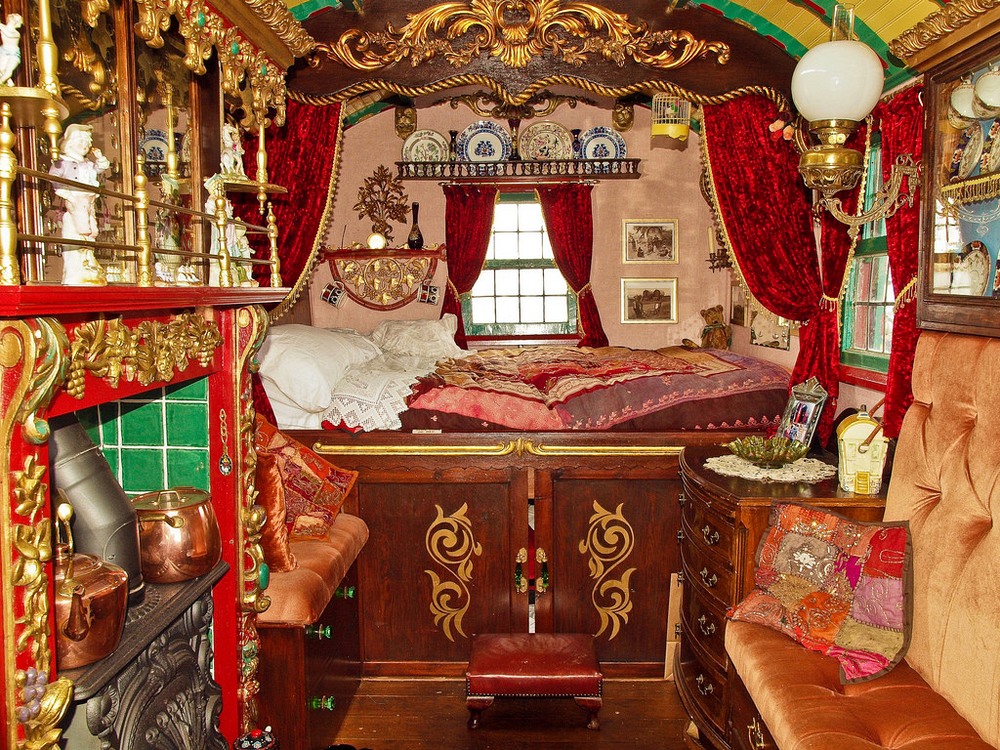
I'm Currently writing book four of the DI Sonny Russell series of crime novels, BLOOD ON THE CARDS. Much of the action revolves around a fairground in the 1950s, when Vardos were commonplace. Here is an extract from the first draft, describing the main suspect and his ornate caravan.
He stopped in front
of an impressive living wagon. It was painted a deep maroon, the panels
expertly lined out in gold, standing on pneumatic tyres. At the foot of the
short flight of steps stood a polished milk churn. Another dog lay beside it,
quiet this time, head on paws, one watchful eye open.
‘Dad!’ the boy
yelled. ‘Da-ad!’
The door of the
wagon opened and man appeared. His frame was stocky, but muscular; his curly
blond hair flopped over his forehead, startling blue eyes flashed beneath. He was
wearing a collarless shirt open to reveal a thick matt of hair, with a red
spotted scarf, knotted round his throat. His legs were clad in a pair of
corduroy trousers, cinched at the waist with a thick leather belt. ‘What?’ he
growled. ‘What do you want? D’you know what time it is?’
The boy shook
himself free. ‘Sorry Dad. These rozzers wanted to talk to you.’ He dashed off
again. They didn’t see him disappear round the corner and run up the steps of
the strongman’s van.
Weeks took a
step forward. ‘Sorry, sir. Could we have a word with you?’
The man scowled,
a look of defiance spoiling his matinee looks. ‘Go on. I’m listening.’
‘Could we come
inside? It’s a rather delicate matter.’
‘I suppose so.’
He turned and went back into the van. The two constables looked at each other.
Nettie mounted the steps followed by Weeks.
The interior of
the wagon was a symphony in mahogany and brass. Everything was polished to a high
gleam, reflected in numerous ornate mirrors. They were invited to sit on a
plush, fitted settee, opposite an immaculate cast iron range. A cheery blaze
flickered behind the glass door.
‘Right then.
What can I do for you?’ He stood in front of the fireplace, his muscular arms
folded across his chest.

I hope to publish BLOOD ON THE CARDS later this year, but meanwhile, the other books in the series are available in paperback or on Kindle. Details are on the right of the blog.


