Followers

Showing posts with label ferry. Show all posts

Tuesday, 6 August 2019

VARDO - Romani Wagon

VARDO
Romani Wagon


Travelling showmen spent most of their lives on the road but instead of pitching tent wherever they went, they had horse-drawn wagons where they cooked, ate, and slept. Later, around the middle of the 19th century, these caravans were adopted as living quarters by the Romani people, commonly called the Gypsies. These people originated from northwestern India, a country their forefathers left some 1,500 years ago and settled in different parts of the world, but mostly in Europe and Mid-West Asia.
The Romanis call their wagons vardo, originating from the Ossetic word “vurdon” for cart. They are smaller than the larger transport wagons the circus troupes used, and thus required fewer horses to pull. They are often highly decorated, intricately carved, and brightly painted. Some are even gilded.
The Gypsies took great pride in their homes on wheels, but as the vardo evolved and grew more ornate, they became more a showpiece than practical sleeping quarters. Indeed, few Gypsies actually slept in them, preferring instead to sleep in tents or beneath the wagon itself. They also lacked sentiment in times of need, having no hesitation in selling them for something else. Yet, when the owner died it was the custom to burn all his belongings, including the vardo, for the Romanis believed that a dead person’s possessions should not be sold. Money and jewellery, however, was left to the family.
Vardos proliferated in the late 19th and early 20th century. This period is often affectionately called “the wagon time” by Romanichal travellers. 
Vardos are categorized into six main styles—Brush wagon, Reading, Ledge, Bow Top, Open lot, and Burton. The general design evolved over time and were named after the home's owners, for their traditional style (Ledge), for the town of its construction (Reading), or for the name of the builder.
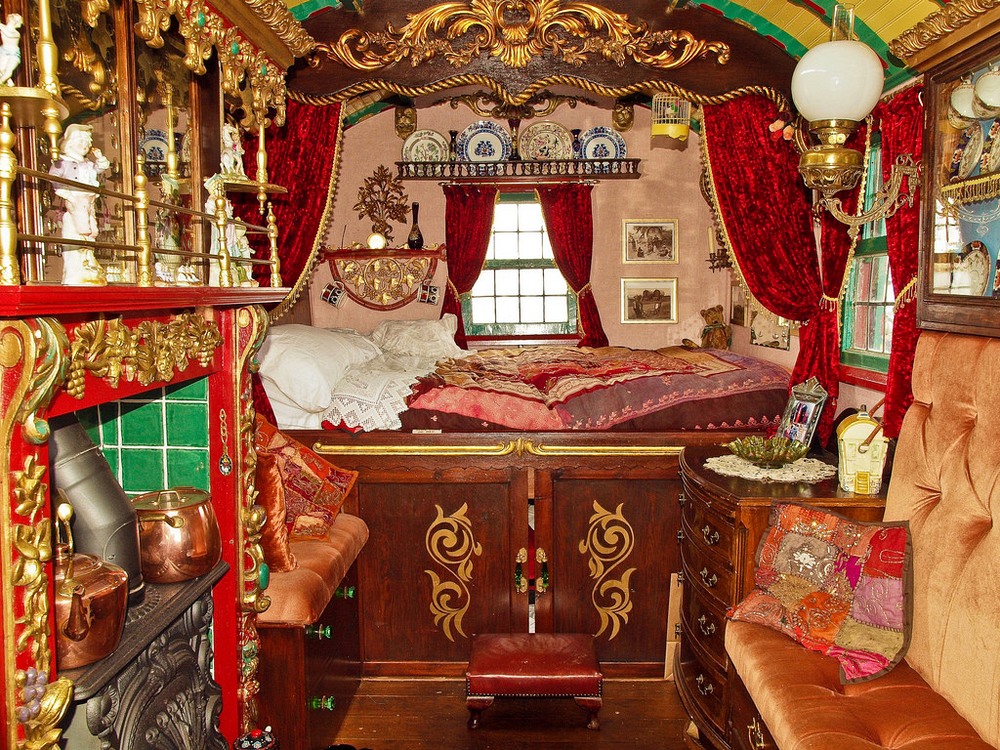
I'm Currently writing book four of the DI Sonny Russell series of crime novels, BLOOD ON THE CARDS. Much of the action revolves around a fairground in the 1950s, when Vardos were commonplace. Here is an extract from the first draft, describing the main suspect and his ornate caravan.

He stopped in front of an impressive living wagon. It was painted a deep maroon, the panels expertly lined out in gold, standing on pneumatic tyres. At the foot of the short flight of steps stood a polished milk churn. Another dog lay beside it, quiet this time, head on paws, one watchful eye open.
‘Dad!’ the boy yelled. ‘Da-ad!’
The door of the wagon opened and man appeared. His frame was stocky, but muscular; his curly blond hair flopped over his forehead, startling blue eyes flashed beneath. He was wearing a collarless shirt open to reveal a thick matt of hair, with a red spotted scarf, knotted round his throat. His legs were clad in a pair of corduroy trousers, cinched at the waist with a thick leather belt. ‘What?’ he growled. ‘What do you want? D’you know what time it is?’
The boy shook himself free. ‘Sorry Dad. These rozzers wanted to talk to you.’ He dashed off again. They didn’t see him disappear round the corner and run up the steps of the strongman’s van.
Weeks took a step forward. ‘Sorry, sir. Could we have a word with you?’
The man scowled, a look of defiance spoiling his matinee looks. ‘Go on. I’m listening.’
‘Could we come inside? It’s a rather delicate matter.’
‘I suppose so.’ He turned and went back into the van. The two constables looked at each other. Nettie mounted the steps followed by Weeks.
The interior of the wagon was a symphony in mahogany and brass. Everything was polished to a high gleam, reflected in numerous ornate mirrors. They were invited to sit on a plush, fitted settee, opposite an immaculate cast iron range. A cheery blaze flickered behind the glass door.
‘Right then. What can I do for you?’ He stood in front of the fireplace, his muscular arms folded across his chest.


I hope to publish BLOOD ON THE CARDS later this year, but meanwhile, the other books in the series are available in paperback or on Kindle. Details are on the right of the blog. 


Thursday, 27 June 2019

TELEPHONE BOX - press button A


TELEPHONE BOX - press button A


Sir Giles Gilbert Scott was an English architect known for his work on Battersea Power Station, Cambridge University Library, Liverpool Cathedral and Waterloo Bridge and for designing the iconic red telephone box.

Before the advent of mobile phones, everybody used GPO telephone boxes. They often smelled rather unsavoury, were cold and draughty but provided a lifeline for those who didn't have a household phone. I well remember putting four (old) one penny coins in the slot, waiting for a reply, then pressing button A, before speaking. If no one answered, you pressed button B and got your money back. I've used them in my books and here are two extracts featuring them. 

BLOOD ON THE SHRINE

"Baker had found plenty of kindling wood around the yard behind the farmhouse and had the stove burning merrily. He put some larger pieces in, shut down the damper and set off to find a phone box. He assumed there would be one in Framfield so headed in the direction of the village. He passed the gate leading down to the level crossing then continued east. After another 10 minutes he reached the outskirts of the village and soon spied the distinctive red form of the Gilbert Scott-designed call box. The street was deserted and he scuttled inside, the door slowly closing behind him. It had the usual smell of stale tobacco smoke and urine. He inserted four pennies in the slot and dialled the number for the pub in Collinghurst, as Tommy had said he would be waiting for his call at that time.

          ‘Hello? Queen’s Head,’ a male voice said.
          He pressed button A. The coins clattered into the box. ‘Oh, hello, is Tommy there?’
          ‘Hang on.’ The line crackled. He could hear the landlord calling, ‘Tommy! Call for you.’
          There was a pause, then, ‘’Ello? Who’s that?’
          ‘It’s me, Laurie.’
          ‘’Ello mate. ’Ow you doin’?’
          ‘I’m alright thanks.’
          ‘’Ave you been to the farm’ouse?’ Waddyer think?’
          ‘Yes, it’s fine. Just as you described.’
          ‘Told you it would be alright.’ Baker could picture Tommy smiling. ‘Where are you now?’
          ‘Call box in Framfield.’
          Atkin’s tone changed. ‘Anybody see yer?’ he growled.
          ‘No mate. It’s all quiet here.’
          ‘Make sure it stays that way. Don’t want nobody gettin’ suspicious.’
          Baker was a bit peeved. ‘Here, hang on…’
          Atkins relented. ‘It’s all right. Keep yer ’air on. Just need to stick to the plan. You stay put and I’ll come and find yer.’
          ‘When are you coming, Tommy?’
          ‘I’ll be over in a day or two. Got enough grub to keep you goin’?’
          ‘Enough for a day or two I guess.’ Baker sounded unsure.
          ‘Don’t worry cocker, you could always go and snare a rabbit,’ Atkins chuckled.
          ‘Or pop into the village shop?’ Baker said hesitantly.
          ‘Don’t you bloody dare!’ Atkins sounded murderous, his mood changing like the wind. ‘I’ll bring the food.’
          ‘All right, Tommy. Don’t worry, I won’t. Just don’t leave me on my own for too long. You know I hate the countryside.’ The pips sounded on the line. ‘I’ll put some more money in,’ Baker said, panic in his voice.
          ‘Don’t bother mate, ring me tomo…..’ Atkins’s voice was cut off as the money ran out.
          Baker put the receiver down gently. The man had the ability to boost your ego or leave you deflated and Atkins’s words had left him feeling hollow. He pushed the heavy door open and set off back to the farmhouse." 


 BLOOD ON THE STRAND


"Nettie made her way to the red phone box, pulled the door open and settled inside, making herself as comfortable as she could for what might be a long wait. She could clearly see several hundred yards down the track. After a number of settled days with warm sunshine the weather was changing. The sky was now leaden and threatening; the wind was fickle, alternating between gentle breaths and gusty blasts, shaking the scrubby trees and almost flattening the Marram grass either side of the track. It looked as if rain wasn’t far off. Nettie hoped she wasn’t going to get soaked.
 However, after 20 minutes, she heard the sound of an engine: a plume of dust rose, and was then blown sideways by the wind. She watched eagerly, just as fat blobs of rain hit the windows of the phone box. As more raindrops fell, washing the dust off the glass, she could see the blue Morris bumping slowly along the track. The rain was starting to fall more forcefully now, the gusty wind blowing it at 45 degrees. She took a chance and made a dash for the Ford. Pulling the door open she jumped inside and pulled it closed behind her.
‘The car’s coming!’"

Wednesday, 12 June 2019

Rain, rain go away...

RAIN, RAIN GO AWAY


As it's now been raining, every other day since Saturday, my thoughts turned to the weather, and how I've written about it. Here is an extract from BLOOD ON THE SHRINE to give you a taste of how I described a downpour that put DC Johnny Weeks in serious danger. 

'The rain continued to fall relentlessly. At the back of the farmhouse a cast-iron downpipe had come adrift from its bracket and had swung sideways. So, instead of the water going into a drain, it was discharging the contents of the gutter down through the coal chute and into the cellar. If the hatch at the top had remained in place it would have flowed harmlessly across the yard, but after Weeks’s efforts the water was now forming a pool around his body. The door at the top of the steps opened, the light from the candles in the kitchen too weak to penetrate beyond the first couple of steps.'


I obviously like writing about the weather because the rainy theme continued in BLOOD ON THE STRAND.

'Aggie was delighted to be out – the weather didn’t bother her. Heads down, Russell and Weeks were striding into the driving rain while she scampered around their feet, tail up, revelling in the scents she found along the shoreline. The two men said very little to each other. The roaring of the wind and crashing of the surf made conversation close to impossible. The storm showed no sign of abating; if anything it was increasing. They had been tramping along for half an hour, the rain finding a way into their waterproofs and wellingtons and starting to soak their clothes. Each was waiting for the other to suggest it was time to turn back when the terrier began barking excitedly. Looking up and peering through the spray they could see a large crate slopping backwards and forwards in the surf; each wave pushing it further up the beach, and then dragging it back again. Splashing into the shallows they succeeded, with a struggle, in dragging it out of the water and a little way up the beach. The crate was roughly three feet square by about two feet tall. It was strongly constructed from stout timbers, firmly nailed in place.'


And more from BLOOD ON THE STRAND

'Nettie made her way to the red phone box, pulled the door open and settled inside, making herself as comfortable as she could for what might be a long wait. She could clearly see several hundred yards down the track. After a number of settled days with warm sunshine the weather was changing. The sky was now leaden and threatening; the wind was fickle, alternating between gentle breaths and gusty blasts, shaking the scrubby trees and almost flattening the Marram grass either side of the track. It looked as if rain wasn’t far off. Nettie hoped she wasn’t going to get soaked.
 However, after 20 minutes, she heard the sound of an engine: a plume of dust rose, and was then blown sideways by the wind. She watched eagerly, just as fat blobs of rain hit the windows of the phone box. As more raindrops fell, washing the dust off the glass, she could see the blue Morris bumping slowly along the track. The rain was starting to fall more forcefully now, the gusty wind blowing it at 45 degrees. She took a chance and made a dash for the Ford. Pulling the door open she jumped inside and pulled it closed behind her.'

Sunday, 26 May 2019

CALM SEA AND A PROSPEROUS VOYAGE.

CALM SEA AND A PROSPEROUS VOYAGE

Rowland Hilder - Newhaven Harbour

The sea has long been an inspiration for artists, writers and musicians. Many of Turner's paintings featured the sea, in all its moods. Benjamin Britten wrote incredibly atmospheric music for his opera, Peter Grimes, called Four Sea Interludes. You only have to close your eyes to imagine the crashing surf and rolling breakers. However, the sea isn't always rough and tempestuous. Two composers, Ludwig van Beethoven and Felix Mendelssohn were inspired to write pieces of music with the title 'Calm sea and a prosperous voyage', with the sea in more passive mood. Rowland Hilder, a twentieth century painter I much admire, painted many peaceful scenes, like the one above. 

The sea plays a large part in my writing, as the detective, DI Sonny Russell, lives in an old railway carriage, close to the shore, so much of the action features the sea, and those connected with it. At times, as in the opening to Blood on the Strand, the sea is an uncontrolled monster, spiteful and menacing hurling spray and threatening lives. At others, I try to portray it in gentler mood, as in this extract from Blood on the Tide. 

Russell is crossing the channel on a ferry, the Cote d'Azure, newly commissioned in the 1950's when the story is set.

The ship was not only clean and bright but fairly quiet. Few passengers seemed to be crossing the Channel at that time. It was a balmy afternoon and the sea was almost flat calm, promising a smooth passage. As the Côte D’Azur steamed out of Dover Harbour he leant on the taffrail, watching the wake tumbling and foaming, the spring sun lighting up the white cliffs. He found the scene quite soothing and felt the worries of the case begin to fade away, although he knew it would only be for a short while. As the white cliffs of England faded into the distance, he strolled contentedly in to the cafeteria, ordered coffee and a pastry and found a vacant seat next to the window. He had brought his notes but was happy to leave the file closed and enjoy the journey. In little more than an hour the coast of France hove into sight and a voice on the Tannoy announced it was time to prepare to disembark. The carefree mood he had enjoyed during the crossing faded as he prepared for what he feared might be a trying time.

You can read more of DI Sonny Russell's adventures with his little Jack Russell, Aggie, in my series of crime novels, set in the post-war 1950's.