Followers

Showing posts with label gypsy. Show all posts

Monday, 12 August 2019

ALEISTER CROWLEY & the esoteric Tarot

ALEISTER CROWLEY
&
The esoteric Tarot

Aleister Crowley was an English occultist, ceremonial magician, poet, painter, novelist, and mountaineer. A prolific writer, he founded the religion of Thelema and published widely over the course of his life.

So begins Chapter 6 of BLOOD ON THE CARDS, the fourth book in the DI Sonny Russell crime series I am currently writing. The story revolves around the death of a fortune teller at a funfair on the Salts at Nottery Quay (a thinly veiled Rye, in East Sussex.)

As Tarot cards play a large part I needed research into their origin and meanings. Back when I as a callow youth I became very intrigued by this branch of divination and even started telling peoples fortunes, using them. I probably wasn't very good but found it fascinating.


As a result of my recent research, I discovered that Aleister Crowley had designed, with paintings by Lady Frieda Harris, a beautiful deck called the Thoth Tarot. I also discovered that he spent his last years in a nursing home/lodging house on The Ridge in Hastings. 


This was in the 1970s and what was left of the building subsequently became the Robert de Mortain pub. Sadly this is no more. Although I understand that it was never a great pub, the building of The Conquerors March, just up the road, sounded its death knell. (It really annoys me that this corporate chain place, not dissimilar to a Beefeater, lacks an apostrophe!)


The pub was demolished and houses have now been rapidly thrashed up on the site and it amuses me to think that the ghost of Aleister Crowley, once called the most evil man in Britain, may haunt these charmless boxes!


Tuesday, 6 August 2019

VARDO - Romani Wagon

VARDO
Romani Wagon


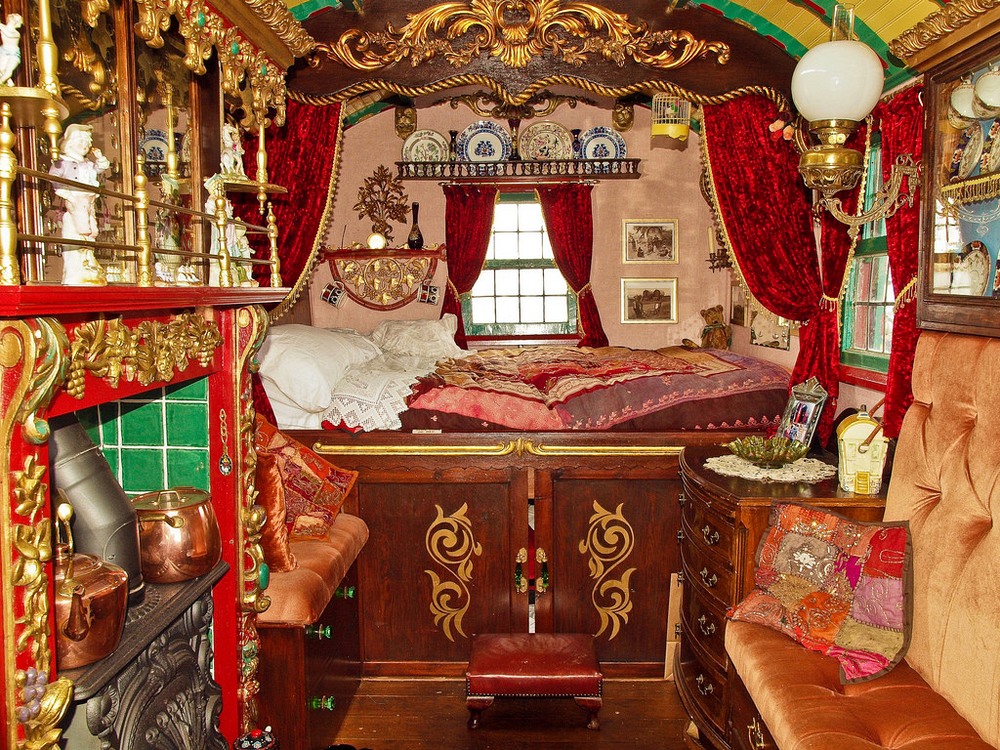
Travelling showmen spent most of their lives on the road but instead of pitching tent wherever they went, they had horse-drawn wagons where they cooked, ate, and slept. Later, around the middle of the 19th century, these caravans were adopted as living quarters by the Romani people, commonly called the Gypsies. These people originated from northwestern India, a country their forefathers left some 1,500 years ago and settled in different parts of the world, but mostly in Europe and Mid-West Asia.
The Romanis call their wagons vardo, originating from the Ossetic word “vurdon” for cart. They are smaller than the larger transport wagons the circus troupes used, and thus required fewer horses to pull. They are often highly decorated, intricately carved, and brightly painted. Some are even gilded.
The Gypsies took great pride in their homes on wheels, but as the vardo evolved and grew more ornate, they became more a showpiece than practical sleeping quarters. Indeed, few Gypsies actually slept in them, preferring instead to sleep in tents or beneath the wagon itself. They also lacked sentiment in times of need, having no hesitation in selling them for something else. Yet, when the owner died it was the custom to burn all his belongings, including the vardo, for the Romanis believed that a dead person’s possessions should not be sold. Money and jewellery, however, was left to the family.
Vardos proliferated in the late 19th and early 20th century. This period is often affectionately called “the wagon time” by Romanichal travellers. 
Vardos are categorized into six main styles—Brush wagon, Reading, Ledge, Bow Top, Open lot, and Burton. The general design evolved over time and were named after the home's owners, for their traditional style (Ledge), for the town of its construction (Reading), or for the name of the builder.

I'm Currently writing book four of the DI Sonny Russell series of crime novels, BLOOD ON THE CARDS. Much of the action revolves around a fairground in the 1950s, when Vardos were commonplace. Here is an extract from the first draft, describing the main suspect and his ornate caravan.

He stopped in front of an impressive living wagon. It was painted a deep maroon, the panels expertly lined out in gold, standing on pneumatic tyres. At the foot of the short flight of steps stood a polished milk churn. Another dog lay beside it, quiet this time, head on paws, one watchful eye open.
‘Dad!’ the boy yelled. ‘Da-ad!’
The door of the wagon opened and man appeared. His frame was stocky, but muscular; his curly blond hair flopped over his forehead, startling blue eyes flashed beneath. He was wearing a collarless shirt open to reveal a thick matt of hair, with a red spotted scarf, knotted round his throat. His legs were clad in a pair of corduroy trousers, cinched at the waist with a thick leather belt. ‘What?’ he growled. ‘What do you want? D’you know what time it is?’
The boy shook himself free. ‘Sorry Dad. These rozzers wanted to talk to you.’ He dashed off again. They didn’t see him disappear round the corner and run up the steps of the strongman’s van.
Weeks took a step forward. ‘Sorry, sir. Could we have a word with you?’
The man scowled, a look of defiance spoiling his matinee looks. ‘Go on. I’m listening.’
‘Could we come inside? It’s a rather delicate matter.’
‘I suppose so.’ He turned and went back into the van. The two constables looked at each other. Nettie mounted the steps followed by Weeks.
The interior of the wagon was a symphony in mahogany and brass. Everything was polished to a high gleam, reflected in numerous ornate mirrors. They were invited to sit on a plush, fitted settee, opposite an immaculate cast iron range. A cheery blaze flickered behind the glass door.
‘Right then. What can I do for you?’ He stood in front of the fireplace, his muscular arms folded across his chest.


I hope to publish BLOOD ON THE CARDS later this year, but meanwhile, the other books in the series are available in paperback or on Kindle. Details are on the right of the blog. 


Monday, 18 March 2019

MEXICAN FLEABANE AND VALERIAN - What's in a name?

MEXICAN FLEABANE & VALERIAN
What's in a name?

Erigeron karvinskianus

Centranthus ruber

It was getting dark; Russell had switched on the standard lamp and was settling down with his book again. Cortot’s rendition of the Chopin preludes was playing softly on the radiogram. He heard a car draw up outside his home; the engine was switched off. He rose from his chair, turned on the outside light and opened the door. Lewis was making his way down the stepping-stone path between the clumps of newly emerging Centranthus and Erigeron.

extract from the soon to be released, Blood on the Strand 

Shinglesea - Chelsea garden

Mexican fleabane, Latin American fleabane, Santa Barbara daisy, Spanish daisy, Karwinsky’s fleabane, or bony-tip fleabane. These are all common names for Erigeron karvinskianus. It grows freely in paths and on steps and I used it in my medal winning Chelsea Flower Show garden, Shinglesea. I was very amused when the BBC presenter, Joe Swift, asked me what it was called. When I told him, he asked for the common name as he couldn't pronounce the Latin when on camera!

Shnglesea - Chelsea garden


Red valerian, spur valerian, kiss-me-quick, fox's brush, Devil's Beard and Jupiter's beard are common names for Centranthus ruber. It grows wild, near the coast and is usually red although it can vary from white, through pink to deep red. I used three colours in my Chelsea garden and I let it self-seed freely around my house not far from the sea.

Me and medal - Shinglesea, Chelsea 2007


Wednesday, 13 March 2019

HASTINGS NET SHOPS

HASTINGS NET SHOPS

This post is by way of a teaser. As the third in the series of DI Sonny Russell crime novels, BLOOD ON THE STRAND, is soon to be published, I thought I'd share a couple of paragraphs from the story. Much of the action takes place around the iconic net huts, or shops, at the Rock-a-Nore fishermen's beach in Hastings. The first photo show the huts as they are now, the second, my interpretation on my layout in a winebox, Castle Quay. If you're interested, details of the the first two books in the series are on the right.

The two men were standing outside Crabbe’s net shop, at the far end of the beach from their own. Similar structures stood all around, their distinctive shapes like blackened fingers, pointing towards the night sky. It wasn’t long before the crunch of boots on shingle announced Crabbe’s arrival. He produced a large key and put it in the rusty padlock.


Sailor Tedham and Frankie Drake were sitting outside their net shop. Drake, perched on a barrel, was splicing a rope while Tedham was perched on an upturned dinghy, smoking his pipe and looking vaguely into the distance. Drake worked deftly, using a fid to push the unwoven strands into the rope, quickly fashioning an eye in the end. When he had finished he put the fid to one side, took a length of waxed twine and quickly parcelled the splice, finishing by cutting the loose ends with his knife. As he picked up another rope to start a new splice, a black Wolseley drew up beyond the further net shop, about a hundred yards away.


Thursday, 21 February 2019

LIGHTS, CAMERA....

LIGHTS, CAMERA...

DI Sonny Russell's railway carriage home

A slight change in direction with this post. It may not be commonly known that the series of DI Sonny Russell crime novels were inspired by a model railway. For my sins, I model narrow gauge railways - the sort of quirky backwater affairs that were built when there wasn't the cash for a standard gauge railway. 

Gull's eye view

My inspiration, for several layouts, has been the Rye and Camber Tram, a three foot gauge line that ran for all of 1 3/4 miles from just outside Rye and ended up in what is now the Rye Golf Club. It lasted from 1895 until 1939 when taken over by the government to carry parts for the PLUTO project. After the war it was so run down that it was sold for scrap. Al that is left is the intermediate, Golf Links station building a some track set in concrete. 
https://en.wikipedia.org/wiki/Rye_and_Camber_Tramway

A visit we made in the centenary. 

Anyway, back to the title of this blog. I took the layout to an exhibition last Saturday. This was the first time that the extension - a definite nod to the R&CT - was to be exhibited. All went well until I tried turning on the lighting. The original LED light pipe over the main Compass Point board worked but the new one over the Shinglesea Halt extension failed. Fuses and connections were checked, to no avail, so that end of the layout remained unlit. However, people commented that it gave it a moody feel and it looked like a storm was brewing.

A storm is brewing over Shinglesea Halt

I returned home, ready to fire off a letter of complaint. Imagine my surprise  - and embarrassment - when I checked the light one last time and found a concealed switch on the body! Now I can choose between a moody or sunlit sky.


Compass Point


Sunday, 10 February 2019

BRONZE - my life as a sculptor

BRONZE
my life as a sculptor

Life-size bronze head

Before I turned my hand to garden design, and then writing novels, I worked as a potter, mouldmaker and modeller. I'd always modelled things - houses, robots, racing cars etc, etc, but never human figures so decided to remedy that. I found an evening class in East Grinstead, so once a fortnight, I would drive over there and spend three and half hours, modelling in clay from a live model. 

Bronze seated man

I found it challenging, stimulating and totally absorbing. When finished the clay could just have been fired to make the sculpture permanent, but, with my contacts, I was able to have several pieces made in cold-cast bronze.
The first, was a small figure of a seated man. In the process of sculpting it, I learned a lot about how fabric falls and folds. The second was a 2/3rds lifesize female figure and the third a full-size head. I loved the classes, taught by a superb sculptor, Babette Adrian, and learned a terrific amount about the human form.

2/3rds life-size bronze.


Saturday, 5 January 2019

WIND extracts from BLOOD ON THE STRAND

WIND
extracts from 
BLOOD ON THE STRAND

James O'Donnell Photography.


Aggie was delighted to be out – the weather didn’t bother her. Heads down, Russell and Weeks were striding into the driving rain while she scampered around their feet, tail up, revelling in the scents she found along the shoreline. The two men said very little to each other. The roaring of the wind and crashing of the surf made conversation close to impossible. The storm showed no sign of abating; if anything it was increasing.

The Shipwrights Arms - Compass Point.

Crossing the railway line he walked along the stony track, past the simple weatherboard structure that served as the station building and up to the Shipwrights Arms. It too was a simple, single-storey structure, but built in local sandstone with a pan-tiled roof, unusual for the area. Sat four square at the end of the quay, hunkered down against the weather, it had withstood gale-force winds, salt spray and lashing rain for more than a century.


After they’d left the shelter of Boulogne Harbour the boat had moved easily to the long swell. But as they’d progressed across the Channel the motion had become less comfortable as the sea became more troubled. The wind had increased with every mile they travelled. Soon it was wailing in the rigging – a discordant keening – a child in the chimney. The craft was sturdy, built to take whatever the weather could throw at it. But even now the timbers groaned and seawater slopped about in the bilge. The two men looked anxiously towards the low shoreline, its featureless contours frequently disappearing in the squally rain.


Thursday, 13 December 2018

THE PILLBOX MURDER

THE PILLBOX MURDER


A few days ago I wrote about my new 'work in progress', BLOOD ON THE CARDS  and mentioned that it was starting in a WW2 pillbox. So, as part of my research, I visited the one I had in mind, on the bank of the Royal Military Canal at Appledore, over the border in Kent. I wanted to get a feel for the location, imagine what it would be like for the police conducting a fingertip search for a murder weapon. Also, I wanted to see what the atmosphere was actually like inside.


It was, as I expected, pretty grim, but not as bad as some I've been in. There was the usual scattering of rubbish - cans, broken glass and litter and, of course, graffiti. Now, as my books are set in the 1950s I don't think it would read PUNKS, maybe, YANKS GO HOME or BAN THE BOMB or maybe nothing. After all, it was only ten years after the war so perhaps it was still relatively pristine.


Anyway, the visit was most fruitful and I can now write about it confidently. 


Friday, 7 December 2018

THE FORTUNES OF WAR - a writer's inspirations

THE FORTUNES OF WAR
a writer's inspirations.

Last week I finished writing BLOOD ON THE STRAND, book three in the DI Sonny Russell series of crime novels. Hurrah! and Oh dear! I felt a sense of satisfaction for sticking to something for over a year coupled with a strange sense of loss. I've felt this before and the best thing, I find, is to get on with the next project - straight away. But what to write?


I've long had an interest in the esoteric, particularly Tarot cards and the germ of an idea featuring them had been lurking at the back of my mind for some time. But how to use them in a story? I remembered I'd come across an actual unsolved case known as The Wirral Pillbox Murder where the body of a prostitute was found in a WW2 pillbox in 1955. Despite a huge manhunt, which saw 40,000 people being quizzed across the country, her murder still remains unsolved. 


Now, if that didn't start my imagination rolling, nothing would. Obviously, I wouldn't use the story - I write fiction, after all, but a fortune teller and a body in a pillbox? A rotten cold has meant an enforced rest from anything physical but pounding a keyboard isn't physical - is it? So, I'm happy to say that BLOOD ON THE CARDS has seen the light of day and is now well underway.