Followers

Sunday, 26 May 2019

CALM SEA AND A PROSPEROUS VOYAGE.

CALM SEA AND A PROSPEROUS VOYAGE

Rowland Hilder - Newhaven Harbour

The sea has long been an inspiration for artists, writers and musicians. Many of Turner's paintings featured the sea, in all its moods. Benjamin Britten wrote incredibly atmospheric music for his opera, Peter Grimes, called Four Sea Interludes. You only have to close your eyes to imagine the crashing surf and rolling breakers. However, the sea isn't always rough and tempestuous. Two composers, Ludwig van Beethoven and Felix Mendelssohn were inspired to write pieces of music with the title 'Calm sea and a prosperous voyage', with the sea in more passive mood. Rowland Hilder, a twentieth century painter I much admire, painted many peaceful scenes, like the one above. 

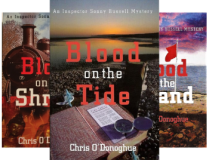
The sea plays a large part in my writing, as the detective, DI Sonny Russell, lives in an old railway carriage, close to the shore, so much of the action features the sea, and those connected with it. At times, as in the opening to Blood on the Strand, the sea is an uncontrolled monster, spiteful and menacing hurling spray and threatening lives. At others, I try to portray it in gentler mood, as in this extract from Blood on the Tide. 

Russell is crossing the channel on a ferry, the Cote d'Azure, newly commissioned in the 1950's when the story is set.

The ship was not only clean and bright but fairly quiet. Few passengers seemed to be crossing the Channel at that time. It was a balmy afternoon and the sea was almost flat calm, promising a smooth passage. As the Côte D’Azur steamed out of Dover Harbour he leant on the taffrail, watching the wake tumbling and foaming, the spring sun lighting up the white cliffs. He found the scene quite soothing and felt the worries of the case begin to fade away, although he knew it would only be for a short while. As the white cliffs of England faded into the distance, he strolled contentedly in to the cafeteria, ordered coffee and a pastry and found a vacant seat next to the window. He had brought his notes but was happy to leave the file closed and enjoy the journey. In little more than an hour the coast of France hove into sight and a voice on the Tannoy announced it was time to prepare to disembark. The carefree mood he had enjoyed during the crossing faded as he prepared for what he feared might be a trying time.

You can read more of DI Sonny Russell's adventures with his little Jack Russell, Aggie, in my series of crime novels, set in the post-war 1950's.

Sunday, 21 April 2019

ACTION! Setting the scene.

ACTION!
Setting the scene

Compass Point - bomb disposal

As documented before on the blog, my 009 layout, Compass Point is the inspiration for my series of DI Russell crime novels. Several of the tableaux I created were featured in the books. Notable amongst them was the scene where a WW2 bomb is being extracted from the mud in the estuary by Captain Valiant and Sapper Rankin.


Now that I'm well into writing the fourth in the series, I am still adding scenes that may be incorporated at some time. I'm currently building a vintage Airfix model of a WW2 'Quad' with 25 pounder gun and limber. I've got this idea that a group of soldiers, on manoeuvres, in the mid 1950s are still using war time equipment. They have lost their way, bumping down a rutted track near Shinglesea Halt, and have stopped to consult the map.


I think it's going to work on the layout, and it's given me an idea for incorporating it into Blood on the Cards, but there's just one small problem. The figures. British army soldiers, in 1/72 and 1/76 scale are readily available, but they are mainly in action poses. There are some very nice wargaming figures, but at only 20mm high they are rather too short, scaling out at about 5 feet tall. So the search goes on.


Tuesday, 16 April 2019

LOOK AT ME! - Making an exhibition of myself

LOOK AT ME!
Making an exhibition of myself


Following on from my last post, Publish - and hope not to be damned, I have just undertaken the launch and book signing of my third novel BLOOD on the STRAND. The Rye Bookshop were kind enough to play host and at 12 noon on Saturday 13th April, I was set up and waiting for customers.

Castle Quay

I'd taken a railway layout I'd built in an empty winebox, called Castle Quay. It was quite relevant as it features models of the Hastings net huts, which play an important part in the book. The shop was busy and it was gratifying to talk to quite a few people who were interested in the book and by 2.30pm I had signed and sold a number of copies.


I'm planning on taking part in a meet the author - and his dog - at several venues in the near future. These include The Romney Marsh Visitor Centre, The Rye Heritage Centre and The Hasting Fishermen's Museum. So watch out for announcements.


Friday, 5 April 2019

PUBLISH - and hope not to be damned

PUBLISH
and hope not to be damned


As a self -published author, I hope to be received kindly and, judging by the response from readers, it seems that people like my writing. Nowadays, it's just not possible to get your manuscripts accepted by a publisher, you have to go through an agent, first. I must have written to well over 50 agents and, when they did reply is was the 'thanks, but no thanks' email. So, still being determined to see my work in print, I set up my own publishing company, BOGHOPPER BOOKS.


It may sound grand, but basically, it's me, working in my railway carriage studio. I have to actively engage with social media, promoting and publicising my books; store my books, then package and send them to those kind enough to buy them, and send out press releases. I promote the books when I give talks to WI, gardening clubs, U3A and other groups. I have to arrange to launch the books in the local Rye Bookshop, which has been very supportive. And... keep in touch with the outlets that stock my books to make sure they have sufficient copies. 

Then, on top of all this I actually have to find time to sit down and WRITE!


Saturday, 30 March 2019

NEW BOOK! - You can judge a book by its cover

NEW BOOK!
You can judge a book by its cover


There's very little more exciting for a writer, than holding the first printed copy of a new book. You've spent getting on for a year, sitting at the keyboard, shaping and crafting prose into a form that you hope will engage readers for 300 hundred pages or so. Then you go over the first draft, chopping out chunks, adding new bits and generally honing it. Next, you give it to an editor, and hope they won't want to change it too much. (I'm lucky as my better half was a sub-editor on The Daily Telegraph for 25 years.) We discuss changes and improvements, which I might or might not agree with. After all it is my book. Then you pass it on to a Beta Reader, a trusted friend who will be honest and also find mistakes that we've missed. 
A friend, another journalist, pointed out, when you write 80,000+ words, you wouldn't be human if you missed some errors. (He also said: What I thought was amazin’ was the punctuation of conversation. Never seen so many apostrophes, and all spot on.)
Next, it goes to the printer, who sets it out then sends you a draft copy which you go over yet again, making a note of changes which need to be made before the final print run.


Once the words are sorted out, getting the cover right is the next task, and probably the most important for sales in bookshops and online. As a designer, I like to try out ideas for the cover, as shown above. I thought mine were quite good but, I realise my limitations, I am not a book cover designer. Luckily, I have a neighbour, with many years experience in graphics, working on magazines. Plus, he is an avid reader and I trust his judgement. He has been happy to produce the covers for all three of my books. And when he showed me the cover he'd come up with for BLOOD ON THE STRAND I couldn't have been happier. Although he had only read the synopsis his image captured the atmosphere of the book perfectly.


So, the book is written and edited, the cover is designed and finally it's printed. But does it stop there? No, of course it doesn't. Now comes the hard graft of publicity and promotion: social media, forums, public appearances, talks, book launches etc etc. You have to be proactive and engage in as many different ways to get readers to buy your baby - there's a mountain of competition out there. Hence, this blogpost which may, or may not result in a sale or two. So over to you, dear reader.


Monday, 18 March 2019

MEXICAN FLEABANE AND VALERIAN - What's in a name?

MEXICAN FLEABANE & VALERIAN
What's in a name?

Erigeron karvinskianus

Centranthus ruber

It was getting dark; Russell had switched on the standard lamp and was settling down with his book again. Cortot’s rendition of the Chopin preludes was playing softly on the radiogram. He heard a car draw up outside his home; the engine was switched off. He rose from his chair, turned on the outside light and opened the door. Lewis was making his way down the stepping-stone path between the clumps of newly emerging Centranthus and Erigeron.

extract from the soon to be released, Blood on the Strand 

Shinglesea - Chelsea garden

Mexican fleabane, Latin American fleabane, Santa Barbara daisy, Spanish daisy, Karwinsky’s fleabane, or bony-tip fleabane. These are all common names for Erigeron karvinskianus. It grows freely in paths and on steps and I used it in my medal winning Chelsea Flower Show garden, Shinglesea. I was very amused when the BBC presenter, Joe Swift, asked me what it was called. When I told him, he asked for the common name as he couldn't pronounce the Latin when on camera!

Shnglesea - Chelsea garden


Red valerian, spur valerian, kiss-me-quick, fox's brush, Devil's Beard and Jupiter's beard are common names for Centranthus ruber. It grows wild, near the coast and is usually red although it can vary from white, through pink to deep red. I used three colours in my Chelsea garden and I let it self-seed freely around my house not far from the sea.

Me and medal - Shinglesea, Chelsea 2007


Wednesday, 13 March 2019

HASTINGS NET SHOPS

HASTINGS NET SHOPS

This post is by way of a teaser. As the third in the series of DI Sonny Russell crime novels, BLOOD ON THE STRAND, is soon to be published, I thought I'd share a couple of paragraphs from the story. Much of the action takes place around the iconic net huts, or shops, at the Rock-a-Nore fishermen's beach in Hastings. The first photo show the huts as they are now, the second, my interpretation on my layout in a winebox, Castle Quay. If you're interested, details of the the first two books in the series are on the right.

The two men were standing outside Crabbe’s net shop, at the far end of the beach from their own. Similar structures stood all around, their distinctive shapes like blackened fingers, pointing towards the night sky. It wasn’t long before the crunch of boots on shingle announced Crabbe’s arrival. He produced a large key and put it in the rusty padlock.


Sailor Tedham and Frankie Drake were sitting outside their net shop. Drake, perched on a barrel, was splicing a rope while Tedham was perched on an upturned dinghy, smoking his pipe and looking vaguely into the distance. Drake worked deftly, using a fid to push the unwoven strands into the rope, quickly fashioning an eye in the end. When he had finished he put the fid to one side, took a length of waxed twine and quickly parcelled the splice, finishing by cutting the loose ends with his knife. As he picked up another rope to start a new splice, a black Wolseley drew up beyond the further net shop, about a hundred yards away.