Followers

Saturday, 30 March 2019

NEW BOOK! - You can judge a book by its cover

NEW BOOK!
You can judge a book by its cover


There's very little more exciting for a writer, than holding the first printed copy of a new book. You've spent getting on for a year, sitting at the keyboard, shaping and crafting prose into a form that you hope will engage readers for 300 hundred pages or so. Then you go over the first draft, chopping out chunks, adding new bits and generally honing it. Next, you give it to an editor, and hope they won't want to change it too much. (I'm lucky as my better half was a sub-editor on The Daily Telegraph for 25 years.) We discuss changes and improvements, which I might or might not agree with. After all it is my book. Then you pass it on to a Beta Reader, a trusted friend who will be honest and also find mistakes that we've missed. 
A friend, another journalist, pointed out, when you write 80,000+ words, you wouldn't be human if you missed some errors. (He also said: What I thought was amazin’ was the punctuation of conversation. Never seen so many apostrophes, and all spot on.)
Next, it goes to the printer, who sets it out then sends you a draft copy which you go over yet again, making a note of changes which need to be made before the final print run.


Once the words are sorted out, getting the cover right is the next task, and probably the most important for sales in bookshops and online. As a designer, I like to try out ideas for the cover, as shown above. I thought mine were quite good but, I realise my limitations, I am not a book cover designer. Luckily, I have a neighbour, with many years experience in graphics, working on magazines. Plus, he is an avid reader and I trust his judgement. He has been happy to produce the covers for all three of my books. And when he showed me the cover he'd come up with for BLOOD ON THE STRAND I couldn't have been happier. Although he had only read the synopsis his image captured the atmosphere of the book perfectly.


So, the book is written and edited, the cover is designed and finally it's printed. But does it stop there? No, of course it doesn't. Now comes the hard graft of publicity and promotion: social media, forums, public appearances, talks, book launches etc etc. You have to be proactive and engage in as many different ways to get readers to buy your baby - there's a mountain of competition out there. Hence, this blogpost which may, or may not result in a sale or two. So over to you, dear reader.


Monday, 18 March 2019

MEXICAN FLEABANE AND VALERIAN - What's in a name?

MEXICAN FLEABANE & VALERIAN
What's in a name?

Erigeron karvinskianus

Centranthus ruber

It was getting dark; Russell had switched on the standard lamp and was settling down with his book again. Cortot’s rendition of the Chopin preludes was playing softly on the radiogram. He heard a car draw up outside his home; the engine was switched off. He rose from his chair, turned on the outside light and opened the door. Lewis was making his way down the stepping-stone path between the clumps of newly emerging Centranthus and Erigeron.

extract from the soon to be released, Blood on the Strand 

Shinglesea - Chelsea garden

Mexican fleabane, Latin American fleabane, Santa Barbara daisy, Spanish daisy, Karwinsky’s fleabane, or bony-tip fleabane. These are all common names for Erigeron karvinskianus. It grows freely in paths and on steps and I used it in my medal winning Chelsea Flower Show garden, Shinglesea. I was very amused when the BBC presenter, Joe Swift, asked me what it was called. When I told him, he asked for the common name as he couldn't pronounce the Latin when on camera!

Shnglesea - Chelsea garden


Red valerian, spur valerian, kiss-me-quick, fox's brush, Devil's Beard and Jupiter's beard are common names for Centranthus ruber. It grows wild, near the coast and is usually red although it can vary from white, through pink to deep red. I used three colours in my Chelsea garden and I let it self-seed freely around my house not far from the sea.

Me and medal - Shinglesea, Chelsea 2007


Wednesday, 13 March 2019

HASTINGS NET SHOPS

HASTINGS NET SHOPS

This post is by way of a teaser. As the third in the series of DI Sonny Russell crime novels, BLOOD ON THE STRAND, is soon to be published, I thought I'd share a couple of paragraphs from the story. Much of the action takes place around the iconic net huts, or shops, at the Rock-a-Nore fishermen's beach in Hastings. The first photo show the huts as they are now, the second, my interpretation on my layout in a winebox, Castle Quay. If you're interested, details of the the first two books in the series are on the right.

The two men were standing outside Crabbe’s net shop, at the far end of the beach from their own. Similar structures stood all around, their distinctive shapes like blackened fingers, pointing towards the night sky. It wasn’t long before the crunch of boots on shingle announced Crabbe’s arrival. He produced a large key and put it in the rusty padlock.


Sailor Tedham and Frankie Drake were sitting outside their net shop. Drake, perched on a barrel, was splicing a rope while Tedham was perched on an upturned dinghy, smoking his pipe and looking vaguely into the distance. Drake worked deftly, using a fid to push the unwoven strands into the rope, quickly fashioning an eye in the end. When he had finished he put the fid to one side, took a length of waxed twine and quickly parcelled the splice, finishing by cutting the loose ends with his knife. As he picked up another rope to start a new splice, a black Wolseley drew up beyond the further net shop, about a hundred yards away.


Sunday, 24 February 2019

RYE & CAMBER TRAM

RYE & CAMBER TRAM


It was Sunday and Weeks had the day off so Russell decided to catch the train down to Compass Point. The line ran close to the end of the unmade track where he lived so it was a short walk to the low wooden platform by the narrow gauge railway line. He stood in front of the simple shelter, waiting for the 10.15. He was whistling Freight Train. Aggie sat obediently at his feet looking up at him in the hope of a treat. Russell kept a supply of her favourite biscuits in his pocket and she didn’t mind at all that they were sometimes covered in fluff or tasted vaguely of cough candy twists.

extract from BLOOD ON THE TIDE


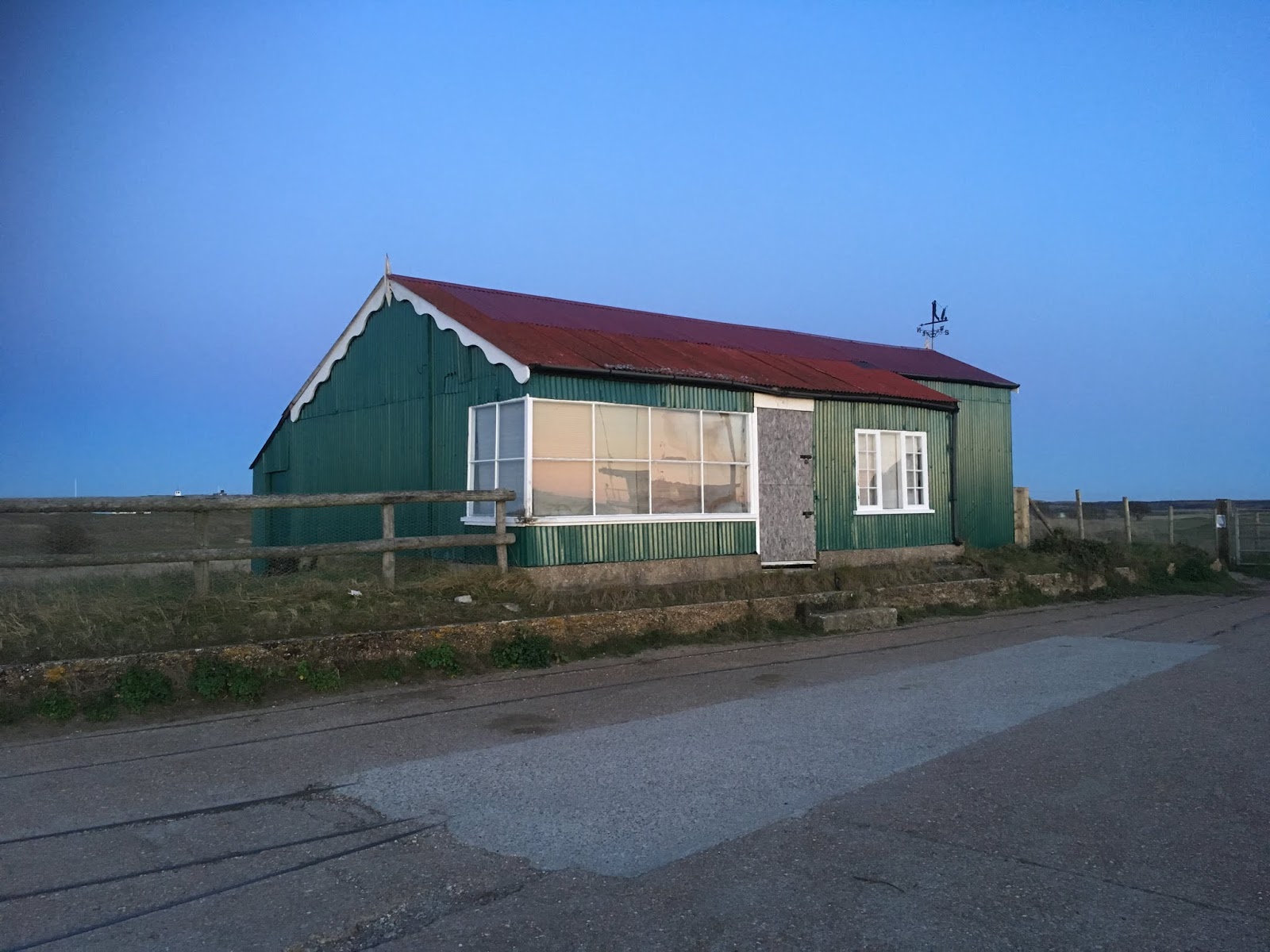
The one time Rye and Camber has long been an inspiration in my modelling, and now in my writing. It plays a key part at Compass Point, which is my interpretation of Rye Harbour. Using artistic licence, I moved the railway from the east bank to the west bank and made it the terminus. In reality Golf Links station, pictured above, was the intermediate station between Rye to the north and Camber Sands to the south.

The railway lasted from 1895 until 1939 when the Government took it over and used it for supplying materials for the PLUTO pipeline. After the war when they returned it the line was in such a parlous stated that it was scrapped


Apart from some track set in concrete, all that is left is the Golf Links station building. Sadly, it is now used as a store by the golf club. Even sadder, the weather vane features a golfer, when it should be a locomotive. You might have guessed I'm not a fan of golf.


Thursday, 21 February 2019

LIGHTS, CAMERA....

LIGHTS, CAMERA...

DI Sonny Russell's railway carriage home

A slight change in direction with this post. It may not be commonly known that the series of DI Sonny Russell crime novels were inspired by a model railway. For my sins, I model narrow gauge railways - the sort of quirky backwater affairs that were built when there wasn't the cash for a standard gauge railway. 

Gull's eye view

My inspiration, for several layouts, has been the Rye and Camber Tram, a three foot gauge line that ran for all of 1 3/4 miles from just outside Rye and ended up in what is now the Rye Golf Club. It lasted from 1895 until 1939 when taken over by the government to carry parts for the PLUTO project. After the war it was so run down that it was sold for scrap. Al that is left is the intermediate, Golf Links station building a some track set in concrete. 
https://en.wikipedia.org/wiki/Rye_and_Camber_Tramway

A visit we made in the centenary. 

Anyway, back to the title of this blog. I took the layout to an exhibition last Saturday. This was the first time that the extension - a definite nod to the R&CT - was to be exhibited. All went well until I tried turning on the lighting. The original LED light pipe over the main Compass Point board worked but the new one over the Shinglesea Halt extension failed. Fuses and connections were checked, to no avail, so that end of the layout remained unlit. However, people commented that it gave it a moody feel and it looked like a storm was brewing.

A storm is brewing over Shinglesea Halt

I returned home, ready to fire off a letter of complaint. Imagine my surprise  - and embarrassment - when I checked the light one last time and found a concealed switch on the body! Now I can choose between a moody or sunlit sky.


Compass Point


Sunday, 10 February 2019

BRONZE - my life as a sculptor

BRONZE
my life as a sculptor

Life-size bronze head

Before I turned my hand to garden design, and then writing novels, I worked as a potter, mouldmaker and modeller. I'd always modelled things - houses, robots, racing cars etc, etc, but never human figures so decided to remedy that. I found an evening class in East Grinstead, so once a fortnight, I would drive over there and spend three and half hours, modelling in clay from a live model. 

Bronze seated man

I found it challenging, stimulating and totally absorbing. When finished the clay could just have been fired to make the sculpture permanent, but, with my contacts, I was able to have several pieces made in cold-cast bronze.
The first, was a small figure of a seated man. In the process of sculpting it, I learned a lot about how fabric falls and folds. The second was a 2/3rds lifesize female figure and the third a full-size head. I loved the classes, taught by a superb sculptor, Babette Adrian, and learned a terrific amount about the human form.

2/3rds life-size bronze.


Thursday, 7 February 2019

STORMY WEATHER

STORMY WEATHER

SHINGLESEA


Detective Inspector Sonny Russell was thoroughly fed up with the weather. He’d been sitting in his railway carriage home for two days, watching the rain batter the windows and listening to the wind howl round the stove chimney like a banshee. Fierce gusts had thundered against the little structure, causing the very fabric to shudder. The storm had been relentless for so long he was starting to get stir-crazy. Apart from opening the back door to collect a scuttle of coal from the bunker and to let Aggie, his little Jack Russell, out for a quick trot round the garden, he had stayed tucked up indoors, the stove pumping out comforting heat, while he read, listened to music and dozed.

extract from BLOOD ON THE STRAND soon to be published

COMPASS POINT

Living by the sea I'm very well aware of subtle changes, and not so subtle changes in the weather. I regularly check the weather forecast although I can often sense when a change is coming. The Met office is most sophisticated now but I'm interested in the way that we were warned in the past about forthcoming storms. Fascinated enough to incorporate a signal mast into my narrow gauge railway layout, Compass Point, which was the inspiration for my DI Russell series of crime novels. On the mast a figure is hauling up a storm cone.

STORM CONES

These cones, made of canvas and rope, were used to warn sailors and mariners of expected storms and gales. 


Also, a slightly simpler system of flags was used. Neither as elaborate as modern methods, but interesting and useful, nonetheless.